Best Button Makers & Badge Machines (2026)
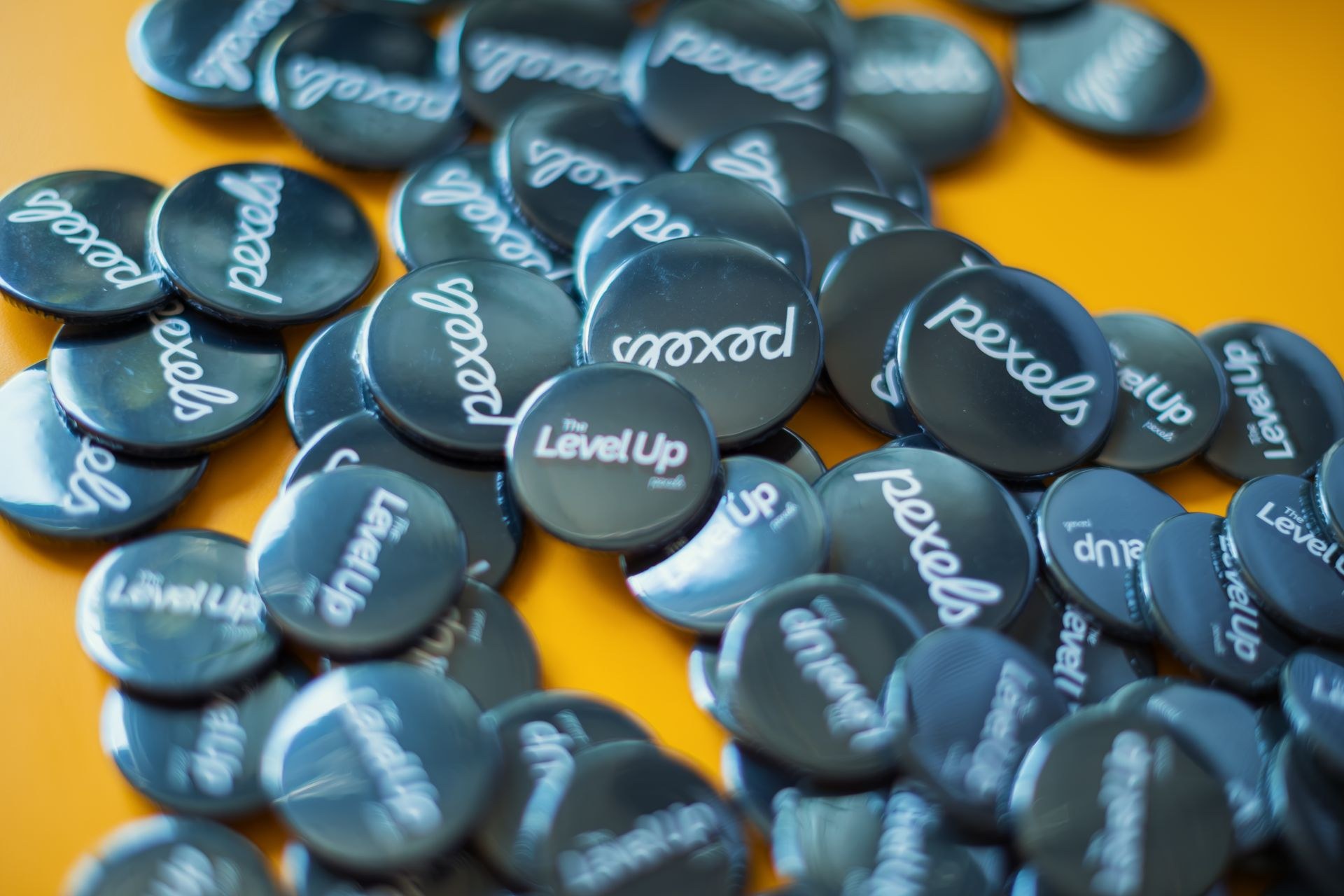
Pinback buttons are one of the best margins in a small shop: a finished 2.25-inch button costs roughly 15–30 cents in parts, sells for $3–5 at a market or in an Etsy shop, and takes under a minute to press once your artwork is cut. They are also the easiest product to ruin with the wrong machine. A press with flexing plastic dies gives you buttons that look fine on the table and pop apart in a customer's bag, and a "58mm" machine from one brand often will not crimp "58mm" parts bought from another — there is no shared sizing standard between import brands, so refills are a buy-from-the-same-seller game.
The six machines below are the ones sellers actually start with, split by the decision that matters: how many sizes you need. One warning before the picks, because it decides which refills you can ever buy: a metric 58mm button is not the same thing as an American Standard 2.25-inch button (57.15mm). Parts from the two systems do not reliably interchange. Pick a system, note it on the box, and reorder parts for that system only.
The short answer
- Best overall: VEVOR 3-in-1 Button Maker, 25/32/58mm (~$80) — one press covers 1, 1.25, and 2.25 inch buttons with 300 parts in the box and an ergonomic arc handle for batch work. Check price on Amazon →
- Best two-size value: Happizza Button Maker, 32+58mm — the two sizes most sellers actually sell, interchangeable metal dies, and 200 sets of parts (100 per size) with circle cutters. Check price on Amazon →
- Best 3-size kit with a work mat: Happizza Button Maker Multiple Sizes (4th Gen), 25+32+58mm — three sizes, 300 sets of supplies, circle cutters, and a cutting mat for the print-cut-press workflow. Check price on Amazon →
- Best for small pins in bulk: Happizza Button Maker 32mm (3rd Gen) — a single-size 1.25 inch press with 500 button parts in the box, the cheapest cost-per-finished-button here for charm-size pins. Check price on Amazon →
- Best budget multi-size: MK.Bear Button Maker, 1.25+2.25 inch — a slide-style green press with both popular sizes and 200 sets of supplies, at starter money. Check price on Amazon →
- Best large format: VEVOR Button Maker 75mm (3 inch) — a rotating metal press for big photo buttons, display badges, and mirrors that read from across a market stall. Check price on Amazon →
VEVOR 3-in-1 Button Maker — the best overall pick
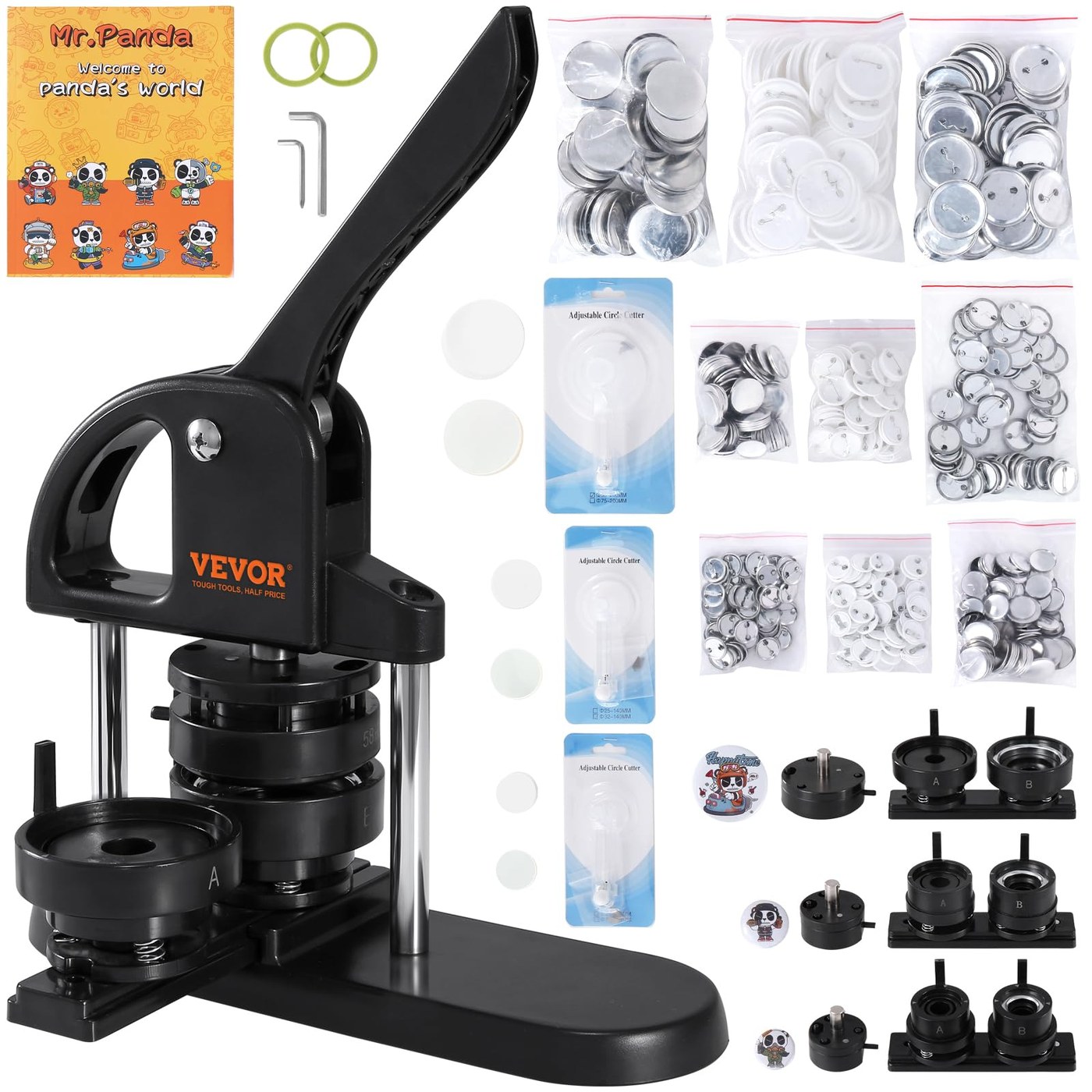
If you do not yet know which button sizes your shop will sell — and most new button sellers do not — this is the safest first press. One machine takes three interchangeable die sets (25mm / 1 inch, 32mm / 1.25 inch, and 58mm / 2.25 inch), so the same press makes small jacket pins, mid-size art pins, and the standard seller-size button without a second machine. The kit includes 300 button parts split across the sizes, circle cutters, and gaskets for the 58mm metal backs. The long arc handle matters more than it sounds: pressing is a two-pull motion per button, and over a 100-button batch the handle geometry is the difference between a sore shoulder and a finished run. The body is ABS plastic with metal dies where it counts, it needs no installation out of the box, and it works with standard 127–157gsm paper. VEVOR rates it for pinbacks and, with the right parts, keychains, bottle openers, and fridge magnets in the same sizes.
Honest pros:
- Three sizes in one press — 1, 1.25, and 2.25 inch dies included, no second machine later
- 300 parts in the box, with both iron and plastic back options for the smaller sizes
- Ergonomic arc handle — genuinely easier on long batch runs than straight handles
- No installation — slide the die in and press; good first machine for a seller learning the workflow
Honest cons:
- Plastic body and die carriers flex more than an all-metal press — press evenly and check the first buttons of every batch
- 300 parts split three ways means about 100 finished buttons per size before your first refill order
- Refill parts must be 25/32/58mm metric parts that match this machine — American Standard 2.25 inch parts are a different fit
Happizza Button Maker 32+58mm — the best two-size value
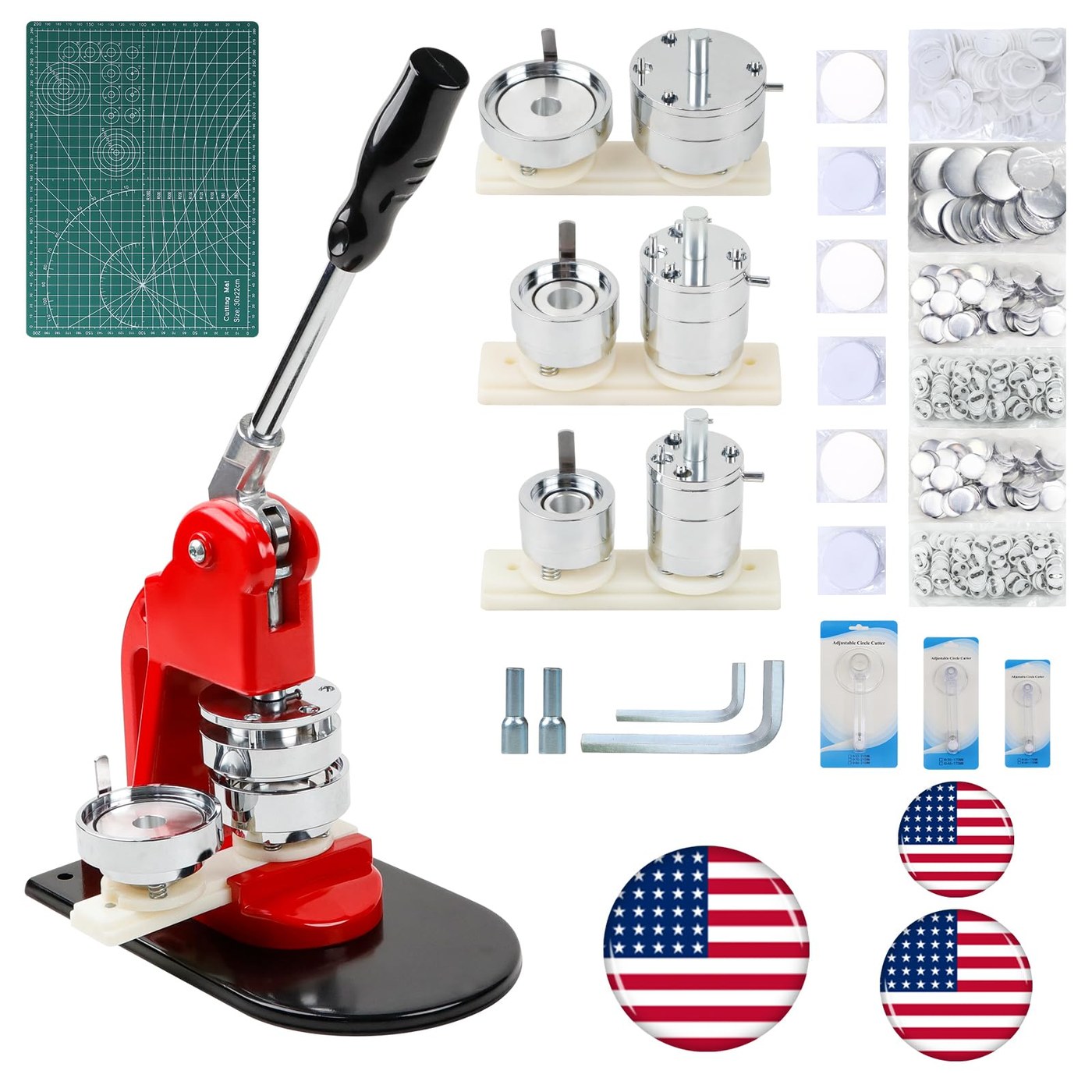
Most sellers end up selling exactly two sizes: 1.25 inch for subtle art pins and 2.25 inch for the designs that need room. This Happizza is built around that pair. The body is iron rather than plastic — a real step up in rigidity for a machine in this class — with two interchangeable die models (32mm and 58mm), two circle cutters, a cutting mat, and 200 sets of parts, 100 for each size, including mylar films and blank round paper. Because the dies swap, you can also buy other Happizza die sizes later and run them on the same press. For a shop that already knows its two sizes, this is the better spend than a 3-in-1: fewer parts you will never use, a sturdier frame, and the same money.
Honest pros:
- Iron body — stiffer presses and more consistent crimps than the plastic-bodied kits
- The two sizes sellers actually sell, with 100 full sets of parts for each
- Cutting mat and both circle cutters included — the full print-cut-press setup in one box
- Die models are replaceable and expandable — other sizes can be added to the same press
Honest cons:
- No 25mm / 1 inch die in the box — tiny band-style pins need a separate die purchase
- Die swaps between sizes take a minute or two — batch one size at a time rather than alternating
- Like all metric machines here, refills should come from the same brand to guarantee the crimp fit
Happizza Button Maker (4th Gen) 25+32+58mm — the best 3-size kit with a work mat
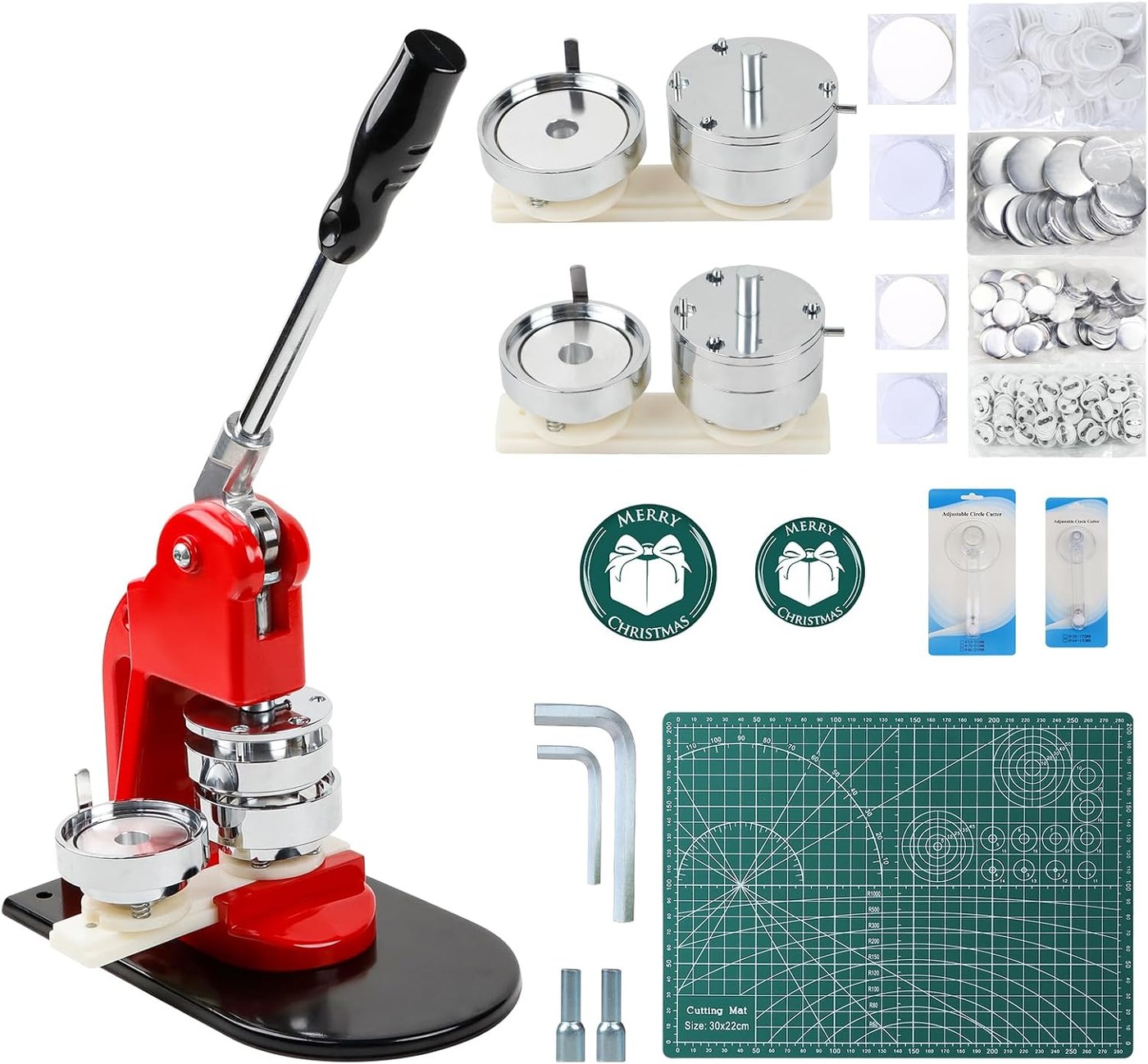
Happizza's 4th generation kit is the direct rival to the VEVOR 3-in-1, and the differences are in the workflow details. You get the same three sizes (25, 32, and 58mm) with interchangeable models, 300 sets of badge supplies (100 per size, including mylars and blank paper), circle cutters for each size — plus a cutting mat, which sounds minor until you are trimming a sheet of printed circles at the kitchen table. The body is high-density reinforced plastic, so it is light enough to take to a market for live custom buttons, and the detachable design packs down smaller than the fixed-frame presses. Choose this one over the VEVOR if the mat and the lighter, more portable build matter; choose the VEVOR if you prefer its arc handle for long home batches.
Honest pros:
- Three sizes and 300 sets of supplies — the largest starter parts count of the 3-size kits here
- Cutting mat included — protects the table and gives cleaner, faster circle cutting
- Light, detachable build — the easiest of these presses to bring to a market or event
- Reinforced plastic body keeps the price down while covering all three sizes
Honest cons:
- Plastic construction — fine for market and shop batches, not the pick for thousands of buttons a week
- Three sizes means three refill sizes to stock — budget for parts in every size you actually sell
- Circle cutters are basic; heavy daily cutting is better with a proper punch or a cutting machine
Happizza Button Maker 32mm (3rd Gen) — the best for small pins in bulk
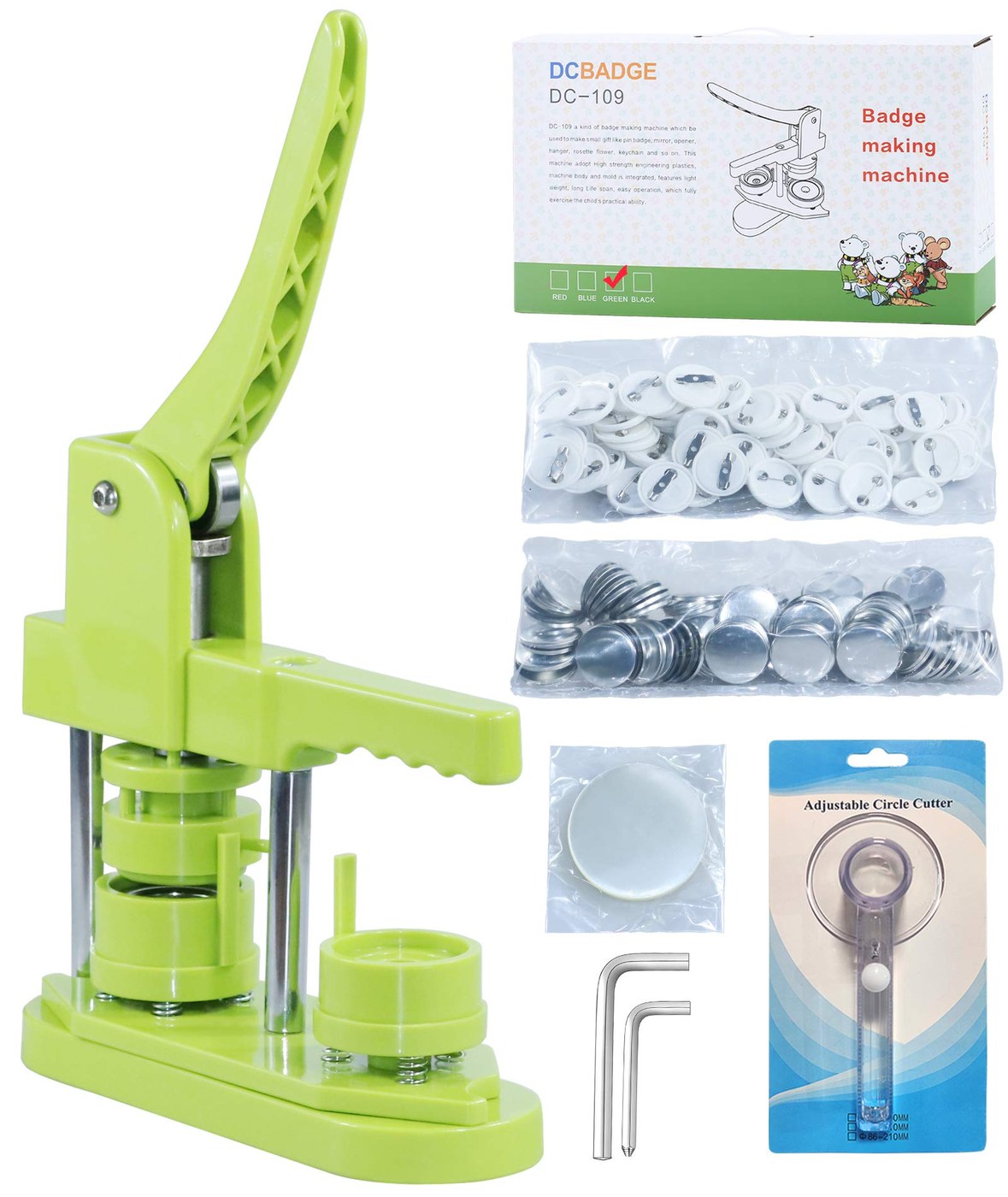
Small 1.25 inch pins are the volume play: they are the add-on at the register, the freebie in a package, and the low-price listing that pulls traffic to a shop. This single-size Happizza is built for exactly that run — an installation-free slide-style press in 32mm only, with 500 button parts and 500 pictures plus an adjustable circle cutter in the box. Five hundred parts changes the math: instead of testing a design on 30 buttons and reordering, you can press a real first batch of several designs and still have stock left. The trade-off is total commitment to one size — this press does nothing else — so buy it when 1.25 inch is a proven seller for you, or as a cheap second press dedicated to your best-selling small design while a multi-size machine handles everything else.
Honest pros:
- 500 button parts included — by far the most finished buttons per dollar in this guide
- Single size means zero die swaps — the fastest repetitive pressing here
- Installation-free slide design — open the box and press the first button in minutes
- Adjustable circle cutter included, sized for the 32mm workflow
Honest cons:
- 32mm only — no path to 2.25 inch buttons on this press
- Plastic construction throughout; technique matters — uneven pressure shows up as uneven crimps
- Small buttons give your artwork very little room — busy designs need simplifying for this size
MK.Bear Button Maker 1.25+2.25 inch — the best budget multi-size
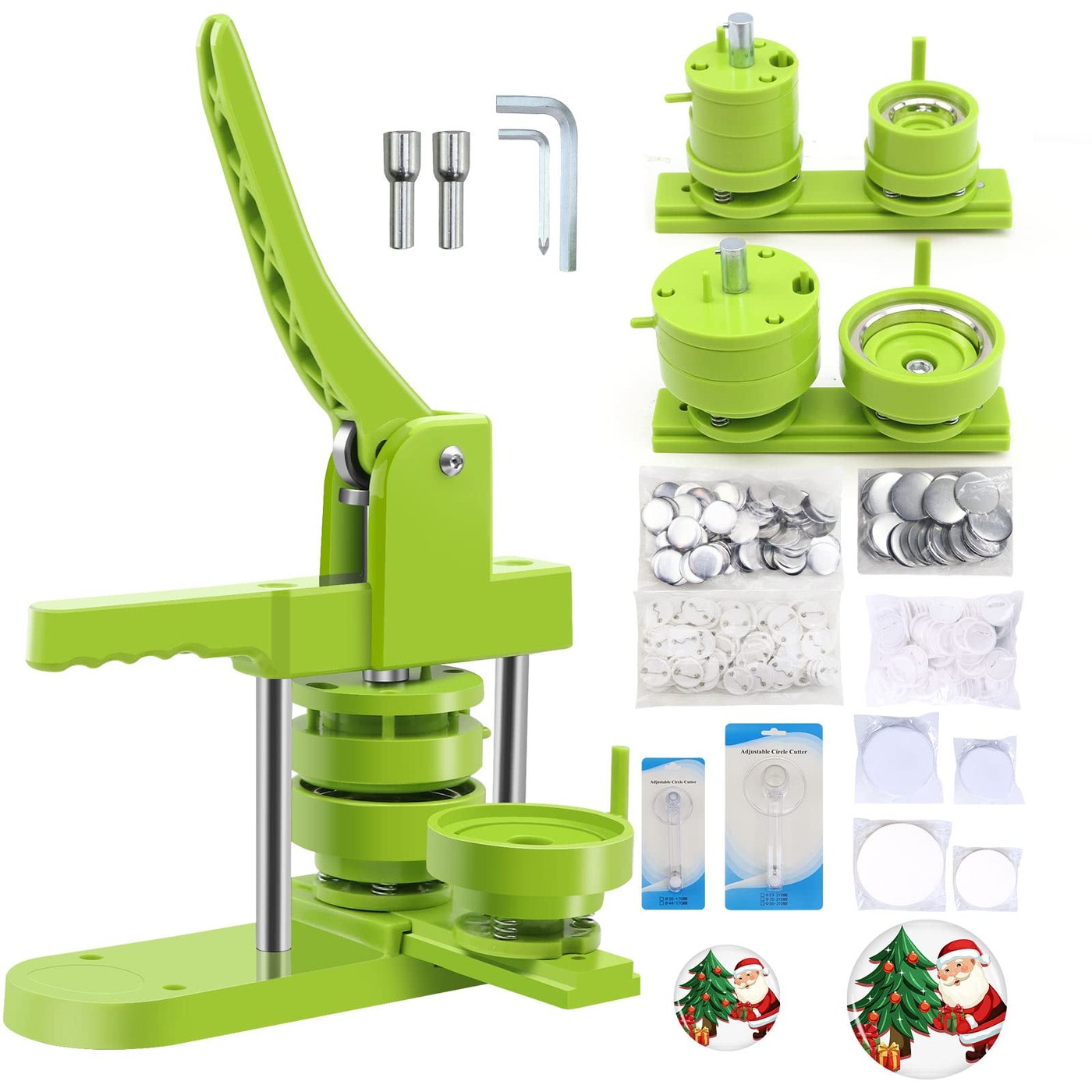
MK.Bear's kit is the budget way to get both popular sizes without dropping to a single-size toy. The green slide-style press takes interchangeable dies in 32mm and 58mm, and the box carries 200 sets of supplies (100 per size) with two circle cutters. The slide design is genuinely beginner-friendly: the lower die slides between the loading and pressing positions, which keeps fingers and artwork aligned better than the swing-arm style when you are learning. It will not outlast an iron-body press under daily production, and the finish on the parts is a step below the Happizza kits — but as a first machine to validate whether buttons sell in your shop at all, it does the whole job for starter money.
Honest pros:
- Both seller sizes (1.25 and 2.25 inch) at the lowest entry price of the multi-size picks
- 200 sets of parts and two circle cutters included — nothing else to buy to start
- Slide-style die is forgiving for beginners — artwork stays put while you press
- Interchangeable dies, so the press is not locked to the two sizes forever
Honest cons:
- All-plastic build — the first thing to flex or crack if you press hard, fast, and daily
- Crimp consistency depends on a firm, even pull — test-press and inspect at the start of each batch
- Refill quality varies by seller — reorder MK.Bear-spec 32/58mm parts, not generic 58mm
VEVOR Button Maker 75mm — the best large format
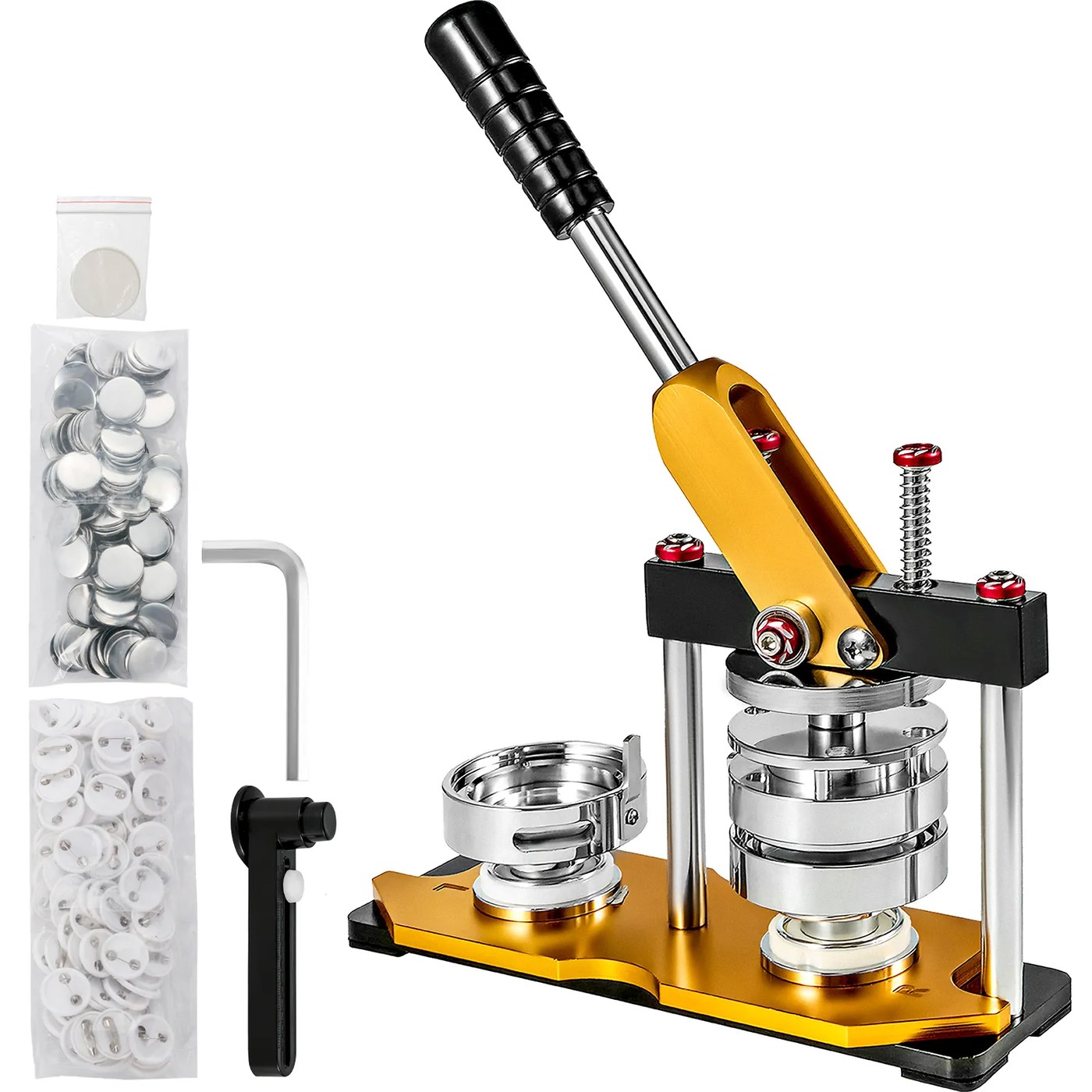
A 3 inch button is a different product: big enough for a full photo, a name and title at an event, or a design that reads from three feet away on a market display. VEVOR's 75mm press is a rotating metal machine — you load the shell and artwork in one station, rotate, add the back, and press — with 100 sets of button parts and a circle cutter in the kit. The metal construction and the rotating base make it steadier than the plastic 75mm toys, and the same format, with the right parts, turns out pocket mirrors, bottle openers, and oversized fridge magnets, which are the high-price items a 3 inch format is really for. It sells one size only, so treat it as a second press for a proven large-format product line, not a starter machine.
Honest pros:
- True 3 inch format — photos, event badges, and display buttons the smaller presses cannot make
- Metal rotating design — steadier and faster per button than a swing-arm at this size
- 100 parts and a circle cutter included; mirror, magnet, and opener parts exist for the same size
- Engineered-metal build holds up better than the plastic large-format alternatives
Honest cons:
- 75mm only — and 75mm parts are the priciest refills per button of any size here
- Bigger buttons need bigger, higher-resolution artwork — phone photos and small web images pixelate
- Overkill as a first press; most sellers should prove the 2.25 inch size first
Side-by-side
| VEVOR 3-in-1 | Happizza 32+58mm | Happizza 4th Gen | Happizza 32mm | MK.Bear Multi | VEVOR 75mm | |
|---|---|---|---|---|---|---|
| Typical price | ~$80 | ~$60 | Check current price | Check current price | Check current price | Check current price |
| Sizes | 25 / 32 / 58mm | 32 / 58mm | 25 / 32 / 58mm | 32mm only | 32 / 58mm | 75mm only |
| Parts included | 300 | 200 sets | 300 sets | 500 | 200 sets | 100 sets |
| Body | ABS plastic, arc handle | Iron | Reinforced plastic | Plastic, slide-style | Plastic, slide-style | Metal, rotating |
| Extras | Circle cutters, gaskets | 2 cutters, cutting mat | Cutters, cutting mat | Adjustable cutter, 500 pictures | 2 circle cutters | Circle cutter |
| Best for | Most new button sellers | Two proven sizes, sturdier frame | 3 sizes, portable market use | 1.25 in pins in bulk | Testing buttons on a budget | 3 in photo & display buttons |
How to choose
Start with the size your product needs, not the most sizes. 1 inch (25mm) is the classic small pin — cheap, subtle, and cramped for anything but a simple icon. 1.25 inch (32mm) is the sweet spot for art pins and add-on sales. 2.25 inch (58mm) is the standard seller size: room for a design plus text, and the size buyers picture when they hear "button." 3 inch (75mm) is for photos and display pieces. If one size covers your whole product idea, a single-size press with a big parts count (the Happizza 32mm) beats a flexible press you only ever use one way.
Respect the 58mm vs 2.25 inch trap. Metric 58mm and American Standard 2.25 inch (57.15mm) buttons look identical on a shelf and are not the same size. Every machine in this guide is a metric machine. Buy your refill shells, backs, and mylar in the metric size, from the same brand where you can, and write the system on your parts bins. Mixing systems is the number one cause of buttons that jam the die or pop apart.
Paper and cutting decide your failure rate. These presses are rated for roughly 127–157gsm paper — standard photo paper works, cardstock jams and cracks, and thin copy paper wrinkles under the mylar. Cut circles cleanly and centered: a slightly off-center cut is a lopsided button. The included circle cutters are fine for starting; sellers cutting hundreds of circles a week usually move the cutting step to a cutting machine or a graphic punch and keep the press for pressing.
Do the margin math before the second press. A finished 58mm button is a shell, a back, a mylar, and your printed circle — typically 15–30 cents all-in at refill prices, against a $3–5 selling price. The machine pays for itself inside the first 30–50 buttons. What actually eats margin is failed presses, so whatever you buy, press five test buttons with your real paper and inspect the crimp edge before running a batch. Buttons pair naturally with the other low-cost merch in our sticker printers guide — same artwork files, second product line — and finished stock stores well in the bins from our craft storage guide.
FAQ
Can I use button parts from a different brand in my machine?
Sometimes, and it is a gamble every time. There is no shared standard between import brands even at the same labeled size, and a shell that is a fraction off will crimp loosely or not at all. Safest rule: reorder parts in the same labeled size from the same brand as the machine. If you switch suppliers, order the smallest pack first and test-press ten buttons before committing.
What paper should I print my button designs on?
Paper in the 127–157gsm range — light photo paper is the common choice. Around 130gsm is the weight several makers recommend by name. Too thin wrinkles under the mylar film; too thick (cardstock) cracks at the crimp and can jam the die. Print a test sheet, press five buttons, and check the edges before printing a full run.
Why do my buttons pop apart or feel loose?
Three usual causes, in order: mismatched parts (wrong system or a different brand's shells), paper that is too thick or too thin for the die, and an incomplete press — the handle needs a firm, full pull on both pressing steps. Fix the parts match first; it accounts for most failures on these machines.
Is a plastic button maker good enough to sell buttons with?
Yes, for shop and market volumes — hundreds of buttons a month is normal work for the plastic kits here, and the finished button does not know what pressed it. What plastic gives up is consistency over very long runs and lifespan over years. If buttons become a core product line doing thousands a month, that is when an all-metal professional press earns its much higher price.
What else can these machines make besides pinback buttons?
With the matching parts for your size: fridge magnets, bottle openers, keychains, and (at 58mm and 75mm) pocket mirrors. The press and dies are the same — only the back piece changes. It is the cheapest product-line expansion a button seller has, which is why the parts ecosystem for your chosen size matters when you pick a machine.