
Best Paper Trimmers for Crafters (2026)

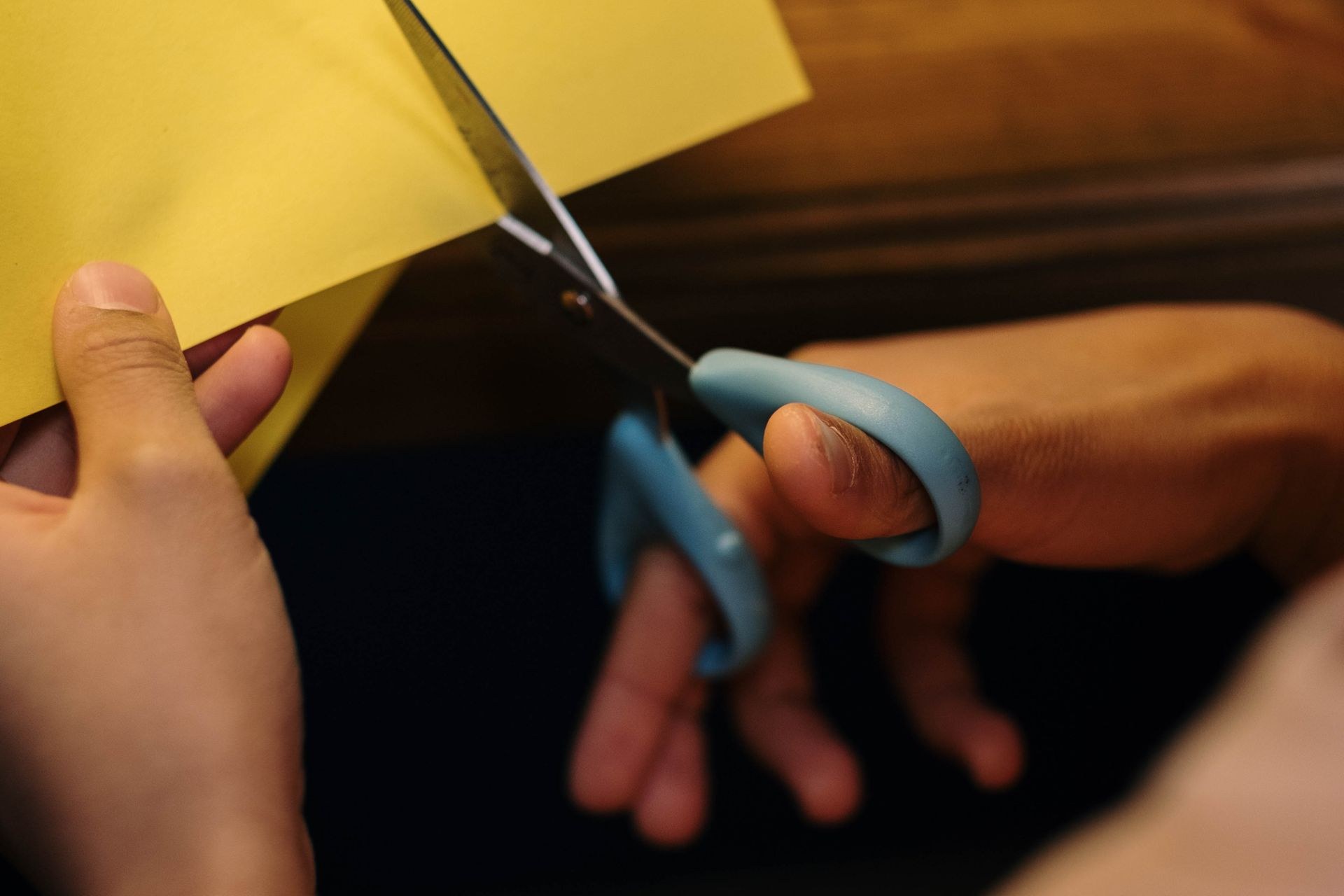
A paper trimmer is the tool that decides whether a finished card, sticker sheet, or art print looks handmade in the good way or handmade in the apologetic way. Scissors wander. A craft knife needs a mat, a ruler, and a steady nerve. A trimmer gives you the same straight, square edge in two seconds, fifty times in a row — which is exactly what a seller trimming packaging inserts, thank-you cards, labels, bookmarks, and 12x12 scrapbook pages actually needs.
What actually matters when you buy one: the cutting style (a sliding blade is safest and best for one or two sheets, a rotary blade is the precision pick for photos and cardstock, and a guillotine is fastest for stacks), cut length (12 inches covers letter, A4, and 12x12 scrapbook paper; a swing-out arm helps you measure wider stock), sheet capacity (honest numbers are for 20 lb paper — cardstock always cuts that rating roughly in half), and what happens when the blade dulls (a replaceable or self-sharpening blade is a running-cost decision, not a detail). The six below run from a pocket-money sliding trimmer to a wood-base guillotine built for batch work.
The short answer
- Best overall for most crafters: Fiskars SureCut Deluxe — 12-inch sliding trimmer with a wire cut-line that shows exactly where the blade will land, a TripleTrack rail that keeps cuts straight, the widest base in its class, and a swing-out arm for larger sheets. Check price on Amazon →
- Best rotary for precision: Dahle 507 — self-sharpening rotary blade that cuts in both directions, an automatic clamp that holds paper still, and a metal base. The photographer's and card-maker's pick. Check price on Amazon →
- Best rotary for heavier stock: CARL RT-200 — carbide rotary blade on a metal base, rated for 10 sheets plus mat board and cardstock, with optional decorative blades for edged cards and invitations. Check price on Amazon →
- Best budget guillotine: Swingline ClassicCut Lite (9312) — 12-inch guillotine that cuts up to 10 sheets at once, with an alignment grid, guard rail, and blade latch, in a light plastic body you can carry to a market stall. Check price on Amazon →
- Cheapest way to start: Firbon A4 — 12-inch titanium sliding trimmer with a safety blade that only exposes under pressure, an angle plate for 45–90 degree cuts, and a replaceable blade. Check price on Amazon →
- Best heavy-duty guillotine: X-ACTO 26315 — solid wood 12x15 base, self-sharpening hardened-steel blade, and a 15-sheet capacity for sellers trimming inserts and cards in batches. Check price on Amazon →
Fiskars SureCut Deluxe — the best overall pick for most crafters
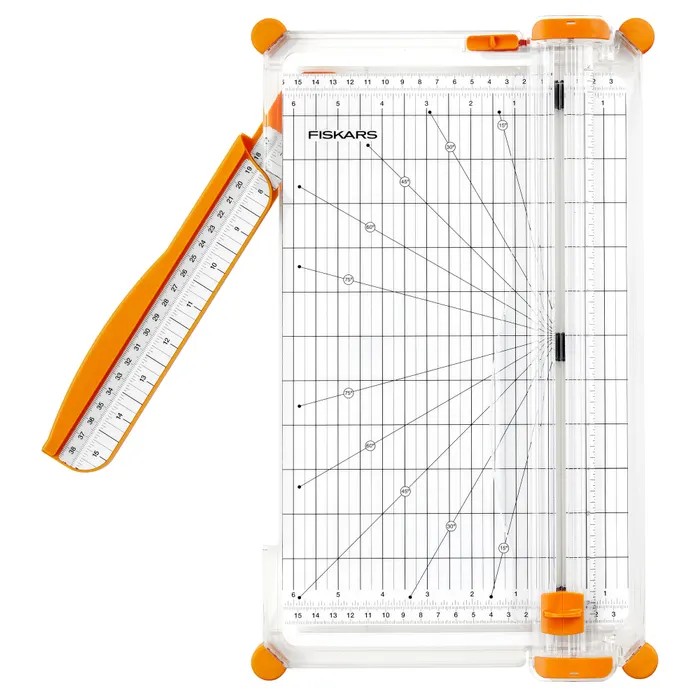
The SureCut Deluxe solves the two problems every sliding trimmer has: you can't see where the cut will land, and the blade wanders. Fiskars' answer is a stainless-steel SureCut wire that runs the length of the rail and shows the exact cut line before you slide, plus a patented TripleTrack system that interlocks the blade carriage and the rail so the cut stays straight instead of curving off at the end of the stroke. The base is the widest in its class (6-1/4 inches), which makes trimming cards and small pieces noticeably easier, the swing-out arm extends the measuring deck to about 15 inches for larger stock, and the whole thing is light enough to live in a drawer. For scrapbook pages, card blanks, photo prints, and packaging inserts, this is the dependable default — and it carries a lifetime warranty, blade excluded.
Honest pros:
- SureCut wire cut-line — you see exactly where the blade will cut before you commit
- TripleTrack rail interlock — straight cuts that don't drift at the end of the stroke
- Widest base in class plus a swing-out arm — easy card work, honest measuring to ~15 in
- Lifetime warranty (blade excluded) from a brand that stocks replacement blades everywhere
Honest cons:
- A sliding blade is a one-or-two-sheets tool — it is not built for stacks or thick chipboard
- Blades are a consumable — budget for TripleTrack replacements, they are model-specific
- 12-inch cut length — oversize stock still needs a bigger trimmer or a cutting machine
Dahle 507 — the precision rotary pick
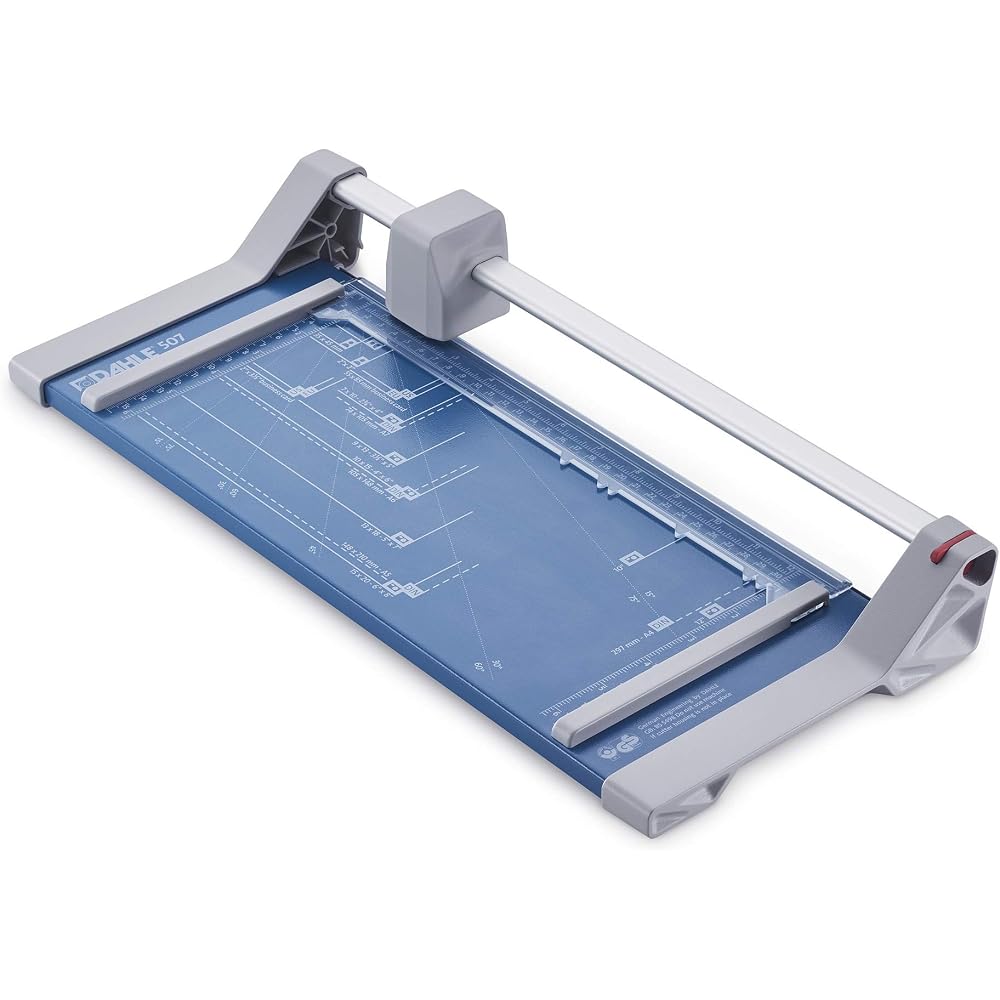
The Dahle 507 is what crafters graduate to when a sliding trimmer's feathered edges start bothering them. Its ground-steel rotary blade is self-sharpening — it hones itself against the base as it rolls — and it cuts in both directions, so there's no wasted return stroke. The automatic clamp is the quiet star: as you start the cut, the clamp presses the sheet down, which is why photos and slippery prints come out square instead of skewed. The metal base carries printed guides for straight and angled cuts, the blade is fully encased in its housing (you never touch an edge), and capacity is an honest 7 sheets of standard paper. German-engineered and backed by a limited lifetime warranty, it's the trimmer for people who measure twice on principle.
Honest pros:
- Self-sharpening rotary blade — clean edges for years, cuts in both directions
- Automatic clamp holds paper and photos still — fewer ruined prints from shifting
- Metal base with straight and angle guides — repeatable, square results
- Blade fully encased — the safest style of trimmer around kids and crowded desks
Honest cons:
- 7-sheet capacity is for standard paper — thick cardstock is a one-or-two-sheet job
- The premium pick among the personal trimmers here
- 12-inch cut length, like the other personal models on this list
CARL RT-200 — the rotary that handles heavier stock
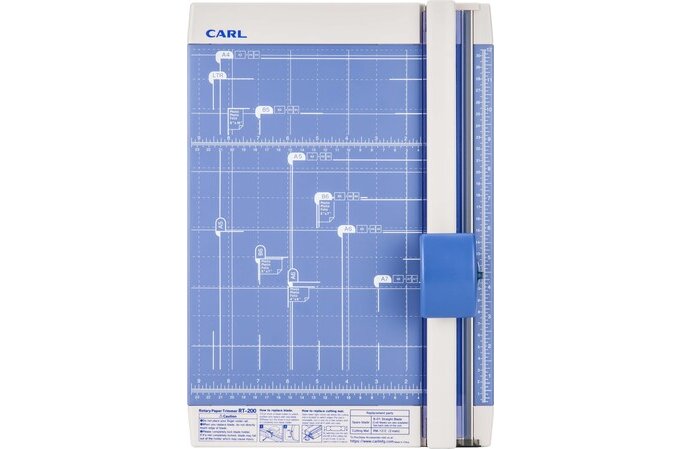
Where the Dahle is about finesse, the CARL RT-200 (model CUI12200) is about range. Its premium carbide rotary blade rides on patented rails over a sturdy, calibrated metal base, and it's rated for up to 10 sheets of standard copy paper — and, unusually for a personal rotary, it also takes mat board, cardstock, and plastic sheets, which makes it a real tool for framing prints and trimming laminated work. The craft trick up its sleeve is the optional B-series blade range: 11 interchangeable cutting patterns (sold separately) for deckled, waved, and perforated edges on cards and invitations. It stores spare blades in the base, and it's covered by a limited lifetime warranty excluding blades and cutting mats. If your product line mixes paper, board, and laminated stock, this is the one-trimmer answer.
Honest pros:
- Carbide blade + metal base — the sturdiest personal rotary on this list
- Cuts mat board, cardstock, and plastic sheet, not just paper
- Optional decorative B-series blades — edged cards and invitations from the same trimmer
- Calibrated base markings and in-base blade storage
Honest cons:
- The decorative blades that make it special are an extra purchase
- Heavier and less drawer-friendly than the sliding trimmers
- Cutting mats are a wear part — heavy users should keep a spare
Swingline ClassicCut Lite 9312 — the budget guillotine
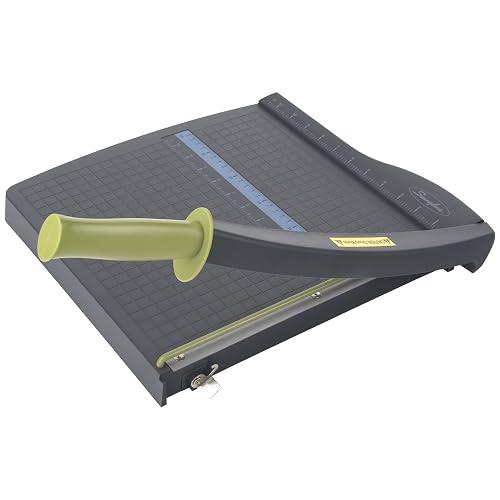
Sometimes the job isn't one perfect sheet — it's forty thank-you cards before a market day. That's guillotine work, and the ClassicCut Lite is the affordable way to do it: a 12-inch guillotine blade that cuts up to 10 sheets of 20 lb paper in one pull, on a sturdy plastic base printed with an alignment grid and a dual-scale ruler in inches and centimeters. Safety is properly handled for an exposed-blade design — a guard rail keeps fingers back while you cut, and a latch hook locks the arm down when it's stored. At about two pounds it's genuinely portable, and Swingline backs it with a limited 10-year warranty. The honest frame: the plastic base flexes more than wood or metal under a full stack, so feed it 6–7 sheets for your cleanest edges and save the rated 10 for plain paper.
Honest pros:
- Cuts up to 10 sheets at once — batch trimming is dramatically faster than any slider
- Alignment grid + dual-scale ruler — accurate without extra measuring tools
- Guard rail and blade latch — the safety basics, done right
- Light, portable, and backed by a limited 10-year warranty
Honest cons:
- Plastic base — less rigid than the X-ACTO's wood base on full stacks
- Guillotine blade is not user-replaceable — when it dulls, the trimmer is done
- An exposed blade style demands respect — latch it, every time, especially around kids
Firbon A4 — the cheapest way to start
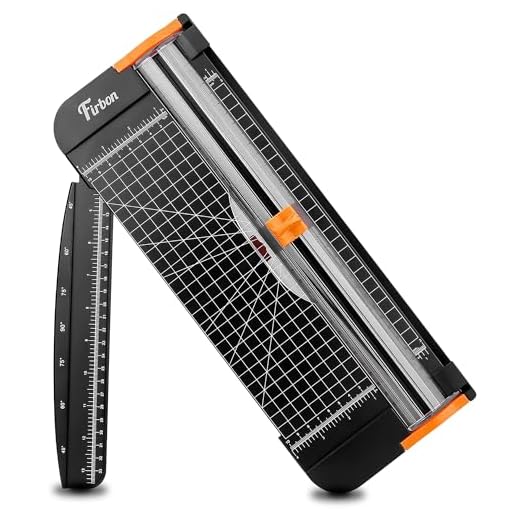
The Firbon is the trimmer that ends up in thousands of first craft rooms, and the design earns it: a 12-inch sliding trimmer with a spring-loaded titanium blade that only exposes itself when you press down to cut — the automatic security safeguard — so it can live in a drawer or a classroom without being a hazard. It handles A3, A4, and A5 paper, photos, cards, coupons, labels, and laminated material up to 1.5 mm, rated at up to 10 sheets of 80 gsm paper per pass (treat that as an optimistic ceiling; two or three sheets is the clean-cut zone). The 45-to-90-degree angle plate and cm/inch scales cover angled cuts for card-making, the side ruler extends for longer stock, and when the blade dulls it pops out and a cheap replacement pops in. That replaceable blade is the whole economic argument: the trimmer costs little and stays sharp for pennies.
Honest pros:
- Pressure-activated safety blade — only exposed while you're actually cutting
- Replaceable titanium blade — dull blades are a small, cheap swap, not a new trimmer
- Angle plate (45–90°) plus cm/inch scales — genuinely useful for cards and labels
- Feather-light and slim — stores in a drawer, travels to markets and classes
Honest cons:
- Sheet-capacity claims are optimistic — cut fewer sheets for clean edges
- Plastic build flexes on thick cardstock — a precision tool it is not
- Budget-brand support and blade quality vary more than Fiskars or Dahle
X-ACTO 26315 — the heavy-duty wood-base guillotine
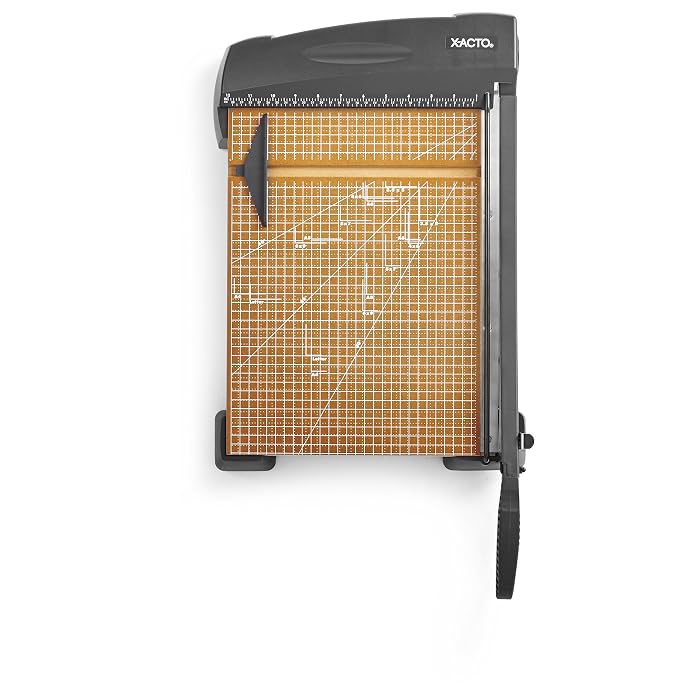
The X-ACTO 26315 is the trimmer that used to live in every school and print room, built the old way: a solid wood 12x15-inch base that doesn't flex, skate, or bow, and a hardened-steel guillotine blade with X-ACTO's Perpetual Edge self-sharpening system, so every cut hones the edge for the next one. It takes up to 15 sheets at once — the highest capacity on this list — with an oversized textured grip for control, a safety guard and latch, and rubber feet that keep the base planted. For a seller trimming packaging inserts, card sets, or printed labels in weekly batches, this is the buy-once option: no consumable blades, no flex, no drift. The trade-offs are size and commitment — it's a permanent resident on your bench, not a drawer tool, and it's priced like furniture, not like a gadget.
Honest pros:
- Solid wood base — zero flex, so stacks cut square, every time
- Perpetual Edge self-sharpening blade — no replacement blades to buy, ever
- 15-sheet capacity — the batch-work champion on this list
- Safety guard, latch, oversized grip, and rubber feet — the full checklist
Honest cons:
- The premium price on this list — overkill for occasional single-sheet trimming
- Big and heavy — it needs a permanent home on your desk or bench
- Guillotine only — no angled-guide finesse or decorative edges
Side-by-side
| Fiskars SureCut Deluxe | Dahle 507 | CARL RT-200 | Swingline ClassicCut Lite | Firbon A4 | X-ACTO 26315 | |
|---|---|---|---|---|---|---|
| Typical price | Check latest price | Check latest price | Check latest price | Check latest price | Check latest price | Check latest price |
| Cut style | Sliding blade | Rotary | Rotary | Guillotine | Sliding blade | Guillotine |
| Cut length | 12 in | 12 in | 12 in | 12 in | 12 in | 12 in (12x15 base) |
| Sheet capacity* | 1–2 sheets cleanly | 7 sheets | 10 sheets | 10 sheets | Up to 10 (80 gsm) | 15 sheets |
| Blade life plan | Replaceable (TripleTrack) | Self-sharpening | Replaceable carbide + mats | Not replaceable | Replaceable | Self-sharpening |
| Base | Plastic, widest in class | Metal | Metal | Plastic | Plastic | Solid wood |
| Best for | Most crafters | Precision & photos | Board & heavy stock | Budget batches | Starting out | Heavy batch work |
*Sheet capacities are manufacturer ratings for standard 20 lb / 80 gsm paper. Cardstock, laminated sheets, and board cut at a fraction of the rating — when in doubt, cut fewer sheets and keep the edge clean.
How to choose
Match the style to the job, not the price tag. Sliding trimmers (Fiskars, Firbon) are the safest and cheapest, and they're the right tool for one or two sheets at a time — scrapbook pages, cards, labels. Rotary trimmers (Dahle, CARL) roll a round blade along a rail, which is why they leave the cleanest edge on photos and cardstock and never expose a blade. Guillotines (Swingline, X-ACTO) trade that delicacy for speed: one pull, a whole stack. Most serious craft sellers end up with a rotary for product work and a guillotine for packaging — in that order.
12 inches is the craft standard — check the measuring arm, not just the cut length. Every trimmer here cuts 12 inches, which covers letter paper, A4, and 12x12 scrapbook stock. What separates them is measuring: the Fiskars' swing-out arm reads to about 15 inches, which matters when you're trimming down larger sheets before the final cut. If you regularly start from 12x18 or larger stock, step up in cut length or cut down on a guillotine first.
Do the blade math before you buy. A trimmer is a blade holder with a ruler attached. Self-sharpening designs (Dahle, X-ACTO) cost more up front and almost nothing to run. Replaceable-blade designs (Fiskars, Firbon, CARL) are cheaper to buy, and the blades are a few dollars each — fine, as long as you buy spares with the trimmer so a dull blade never stops a market-day prep session. The one design to avoid for heavy use is a non-replaceable blade (the Swingline's): fine for light duty, a dead end for a production tool.
Pair it with the rest of the paper workflow. A trimmer finishes what a printer starts — if your prints are the weak link, our printers for Etsy sellers guide covers the machines that feed a trimmer well. Laminated sheets trim cleanest on a rotary, and our laminators guide covers the hot and cold modes that produce them; for shapes no straight trimmer can cut, our cutting machines guide covers Cricut and Silhouette. However you cut, protect the finished stack with the flat-shipping approach in our packaging supplies guide.
FAQ
What is the difference between a sliding, rotary, and guillotine trimmer?
A sliding trimmer drags a small blade along a rail — safest, cheapest, best for one or two sheets. A rotary trimmer rolls a circular blade along a rail — the cleanest edge on photos and cardstock, still fully encased and safe, and the precision choice. A guillotine brings a long blade down through a stack in one motion — fastest for batches of 10–15 sheets, but it's an exposed blade that demands a guard, a latch, and respect.
Can a paper trimmer cut cardstock and laminated sheets?
Yes, within limits. Every capacity rating is for thin 20 lb paper, so treat thick cardstock as a one-or-two-sheet job on sliding and rotary trimmers, and feed laminated sheets sealed-edge first. Rotary trimmers (the Dahle and CARL here) handle cardstock and laminated stock best; the CARL is also rated for mat board and plastic sheet. If a cut starts feathering, the answer is fewer sheets or a fresh blade — never more force.
Why are my cuts crooked or feathered?
Crooked cuts come from the sheet shifting: hold it firmly against the guide edge, use the clamp or grid, and don't start the stroke until the sheet is seated. Feathered or torn edges mean a dull blade or too many sheets — replace the blade (or run a self-sharpening blade through a few empty passes on scrap) and cut a smaller stack. On sliding trimmers, one firm, steady stroke beats three hesitant ones.
How long does a trimmer blade last?
It depends on what you cut: plain paper is gentle, cardstock and laminated stock are abrasive. A sliding blade typically stays crisp for a few hundred cuts of mixed stock; rotary carbide and self-sharpening blades last far longer. The practical rule for sellers: keep a spare blade (or cutting mat, for the CARL) in the drawer from day one, and swap at the first feathered edge — a dull blade ruins more product value in one batch than a replacement costs.