Best Resin Kits for Beginners (2026)
A resin kit is the fastest way into one of Etsy's most reliable craft categories. Coasters, keychains, earrings, bookmarks, and trays all start the same way: measure, mix, color, pour, wait. A good beginner kit puts the resin, molds, pigments, and tools in one box so your first pour happens this weekend — and teaches you the two skills everything else depends on: getting the mix ratio right and pouring bubble-free. If you hate it, you are out one kit. If you love it, you know exactly which molds and colors your first product line needs.
What actually matters when you compare kits: the resin type (two-part epoxy is the beginner standard — cheap per ounce, forgiving, and right for coasters and trays; UV resin cures in minutes under a lamp and suits small jewelry, but costs far more per gram), how much resin you really get (16 oz is a taster that makes a handful of coasters; 32 oz is a real first batch), the working time (about 40 minutes on most epoxy kits here — enough to color and pour calmly, not enough to answer your phone mid-pour), and whether molds, pigments, and gloves are in the box or a second order. The six below cover every honest starting point, from a coaster-first starter to the UV shortcut and the resin-only restock you graduate to.
The short answer
- Best overall: LET'S RESIN Coaster Kit — 16 oz of epoxy with round, hexagon, and square coaster molds, mica colors, gloves, and a proper manual. The brand beginners get recommended most, in a complete box. Check price on Amazon →
- Best value / most resin: KISREL Epoxy Resin Kit 32 oz — double the resin of most starter kits, plus coaster molds, 8 pigments, mica powders, dried flowers, and glitter. The lowest cost per pour here. Check price on Amazon →
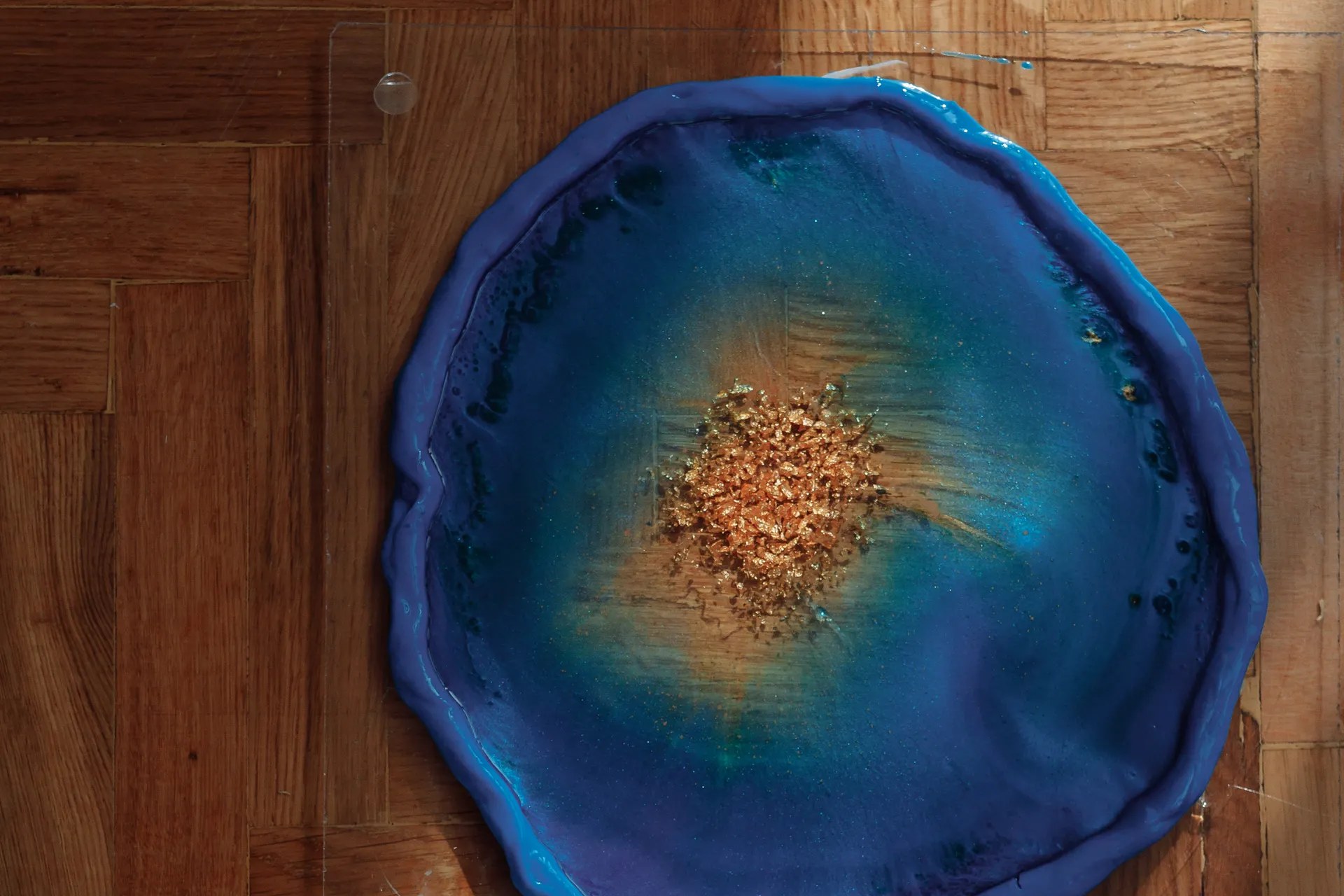
- Best coaster colors: Teexpert Epoxy Resin Kit (~$30) — 16 oz with 6 liquid pigments, mica, and gold flakes; the ocean-coaster look is this kit's home turf. Check price on Amazon →
- Best mold variety: HeyClear Epoxy Resin Kit — 18 oz with 5 molds (sphere, pyramid, heart, cube, and round), a silicone mat, dried flowers, and two kinds of glitter in an 83-piece box. Check price on Amazon →
- Best resin-only step up: LET'S RESIN 34 oz Epoxy Resin Kit (list $23.99) — 34 oz of resin with 6 mica colors and no molds. Buy it when you already own molds and just need more resin. Check price on Amazon →
- Best fast-cure / UV pick: KISREL UV Resin Jewelry Making Kit — 300 g of UV resin with a lamp, molds, and jewelry findings. No mixing, cured in minutes; small pieces only. Check price on Amazon →
LET'S RESIN Coaster Kit — the best overall pick
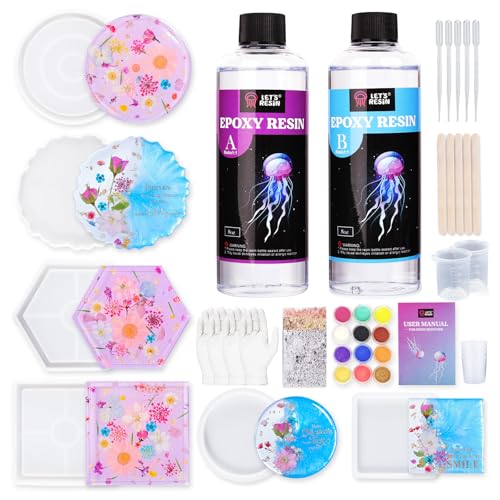
This is the kit to buy if you want one box, a known brand, and coasters as your first project. You get 16 oz of epoxy resin (8 oz resin + 8 oz hardener, 1:1 by volume), silicone coaster molds in round, hexagon, and square shapes, a set of mica colors, gloves, measuring cups, mixing sticks, droppers, and a printed user manual. LET'S RESIN's formula is the one beginner communities recommend for a reason: roughly 40 minutes of working time, an 8–24 hour cure, and a hard, glossy finish that releases cleanly from silicone molds up to about an inch thick per pour. The coaster-first focus is a feature, not a limit — coasters are flat, forgiving, and sellable, which makes them the right first teacher.
Honest pros:
- Complete and focused — resin, 3 mold shapes, colors, gloves, and tools in one box
- ~40 minutes of working time — calm coloring and pouring for a first-timer
- A real printed manual — ratio, warming, and bubble tips where you need them
- The brand's larger resins are an easy step up when the first 16 oz runs out
Honest cons:
- 16 oz goes fast — a set of thick coasters can use most of the kit
- Coaster molds only — jewelry and 3D shapes need a separate mold order
- Like all epoxy here, it is a full-day cure — no same-day finished pieces
KISREL Epoxy Resin Kit, 32 oz — the best value pick
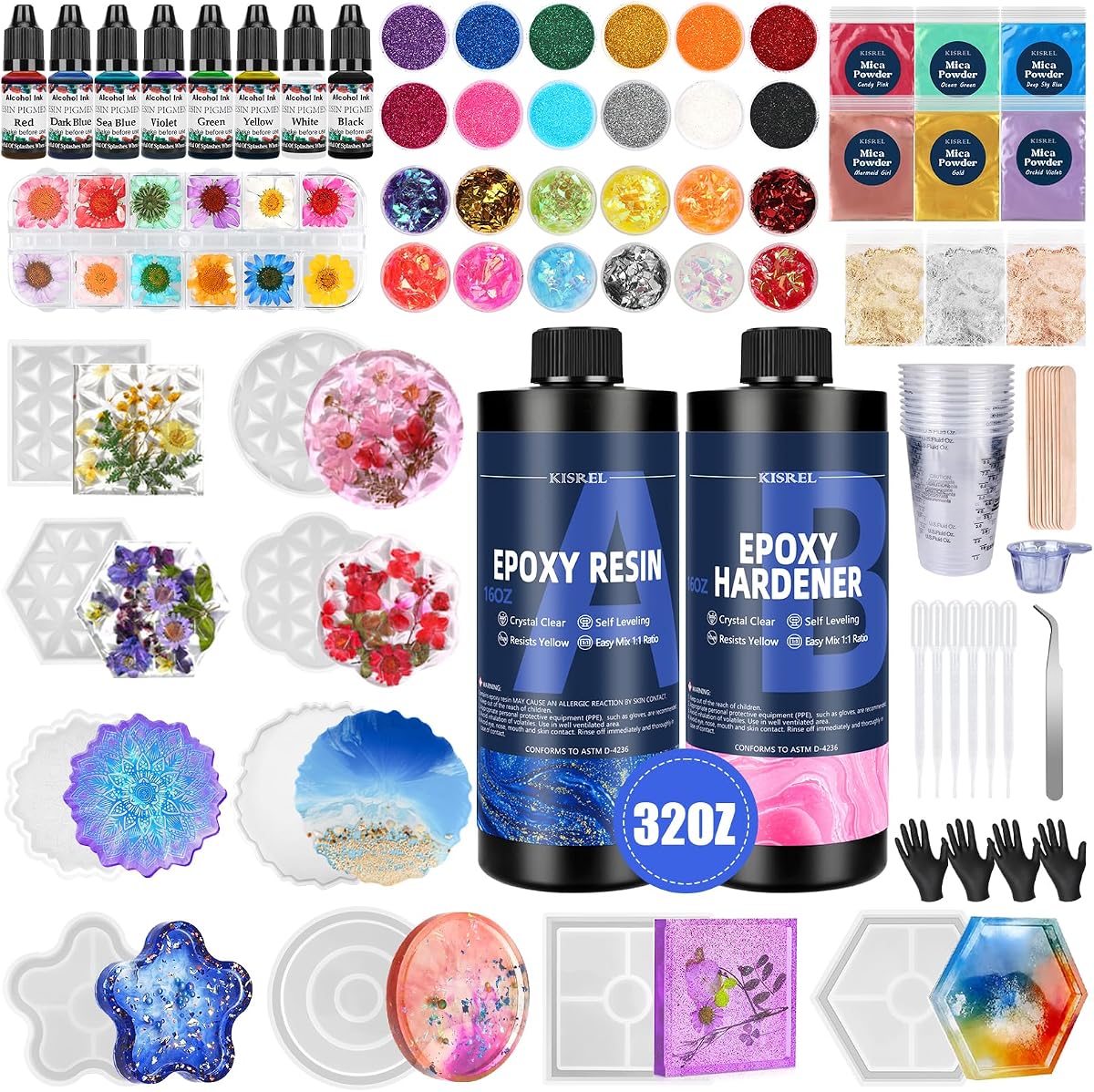
Most starter kits give you 16 oz of resin and a long accessory list. The KISREL flips the emphasis: 32 oz of epoxy (16 oz resin + 16 oz hardener) — double the pours — plus coaster molds, 8 resin pigment colors, 6 mica powders, dried flowers, glitter and foil flakes, measuring cups, gloves, droppers, and tweezers. That matters more than it sounds: beginners waste resin learning. Your first pours will have bubbles, a sticky batch from a rushed mix, and one color you immediately regret. With 32 oz in the box, those lessons do not end the hobby — there is still resin left for the coasters you actually want to keep or list. Cost per ounce, this is the cheapest way on this list to find out whether resin is your craft.
Honest pros:
- 32 oz of resin — twice the learning room of a standard 16 oz starter kit
- 8 pigments + 6 mica powders + dried flowers — the widest color-and-inclusion set here
- Coaster molds, cups, gloves, and tweezers included — nothing else to order first
- 1:1 mix, crystal-clear, self-leveling formula that resists yellowing
Honest cons:
- The accessory count is generous but basic — serious makers upgrade molds quickly
- Instructions are thinner than LET'S RESIN's manual — watch the ratio carefully
- 32 oz is still casting resin for small pieces — not a deep-pour or tabletop resin
Teexpert Epoxy Resin Kit — the coaster color pick
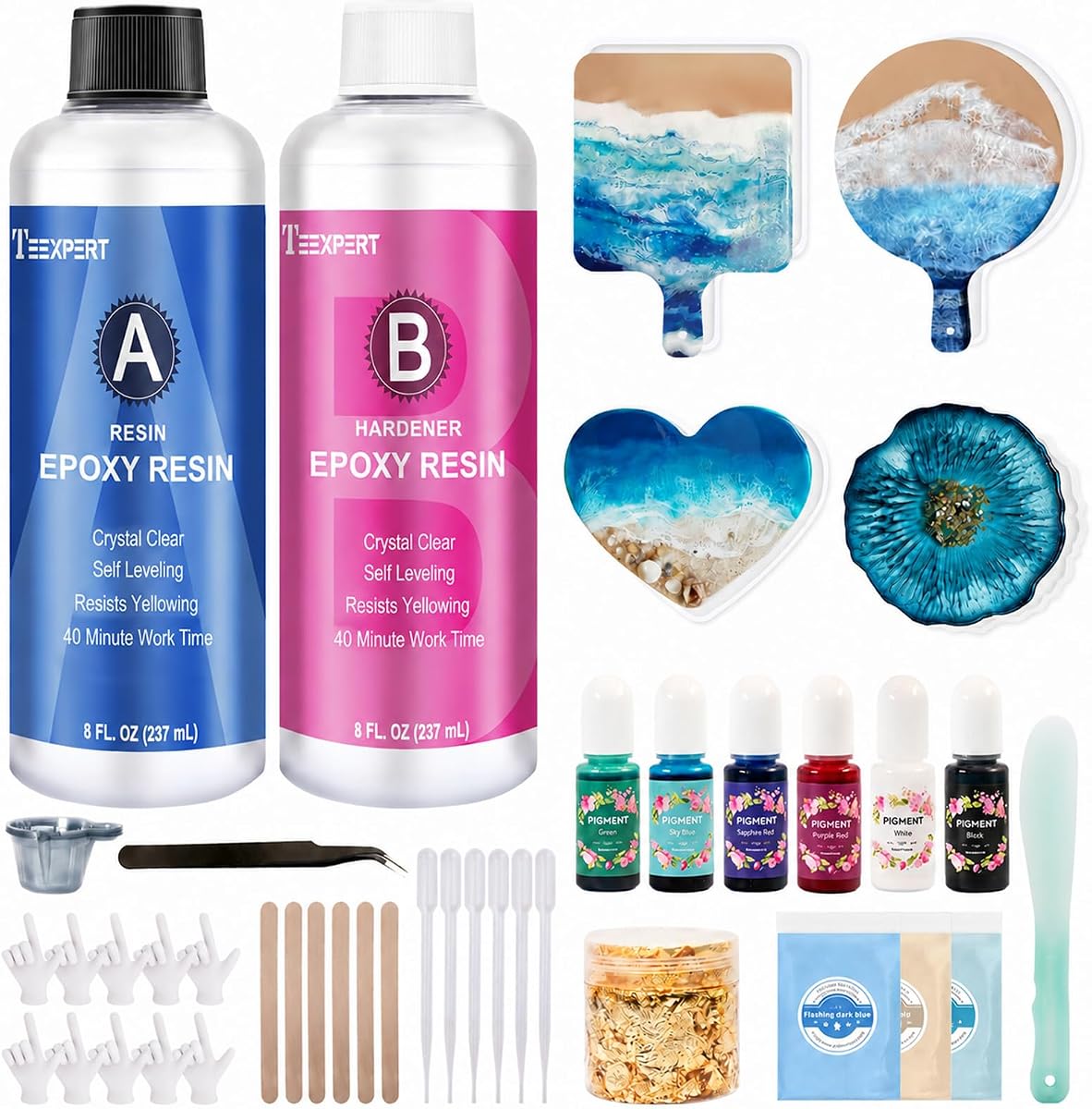
The Teexpert kit is built around one look beginners chase first: ocean and geode coasters. Inside are 16 oz of epoxy (8 oz + 8 oz), 4 silicone coaster molds, 6 liquid pigments (the blues and greens those wave effects need), 3 mica powders, gilding flakes, measuring and mixing cups, sticks, droppers, tweezers, and disposable gloves. The resin itself is a solid beginner formula — 1:1 mix, about 40 minutes of working time printed right on the bottle, demold in 8–10 hours, full cure in 24 hours, and a hard 82D finish. Liquid pigments are the right call for coasters specifically: they swirl and blend in wet resin the way mica powders alone never quite do. If your first product idea is a coaster set, start here.
Honest pros:
- 6 liquid pigments + mica + gold flakes — the ocean/geode palette in one box
- 40-minute working time and 8–10 hour demold — a forgiving beginner schedule
- Clear, self-leveling resin that resists yellowing — colors stay true
- Gloves, cups, and tweezers included — ready to pour on day one
Honest cons:
- 16 oz is a starter quantity — a four-coaster set in several colors uses it quickly
- Coaster molds only, like the LET'S RESIN — other shapes are a second purchase
- Pigments are small bottles — popular colors run out before the resin does
HeyClear Epoxy Resin Kit — the mold variety pick
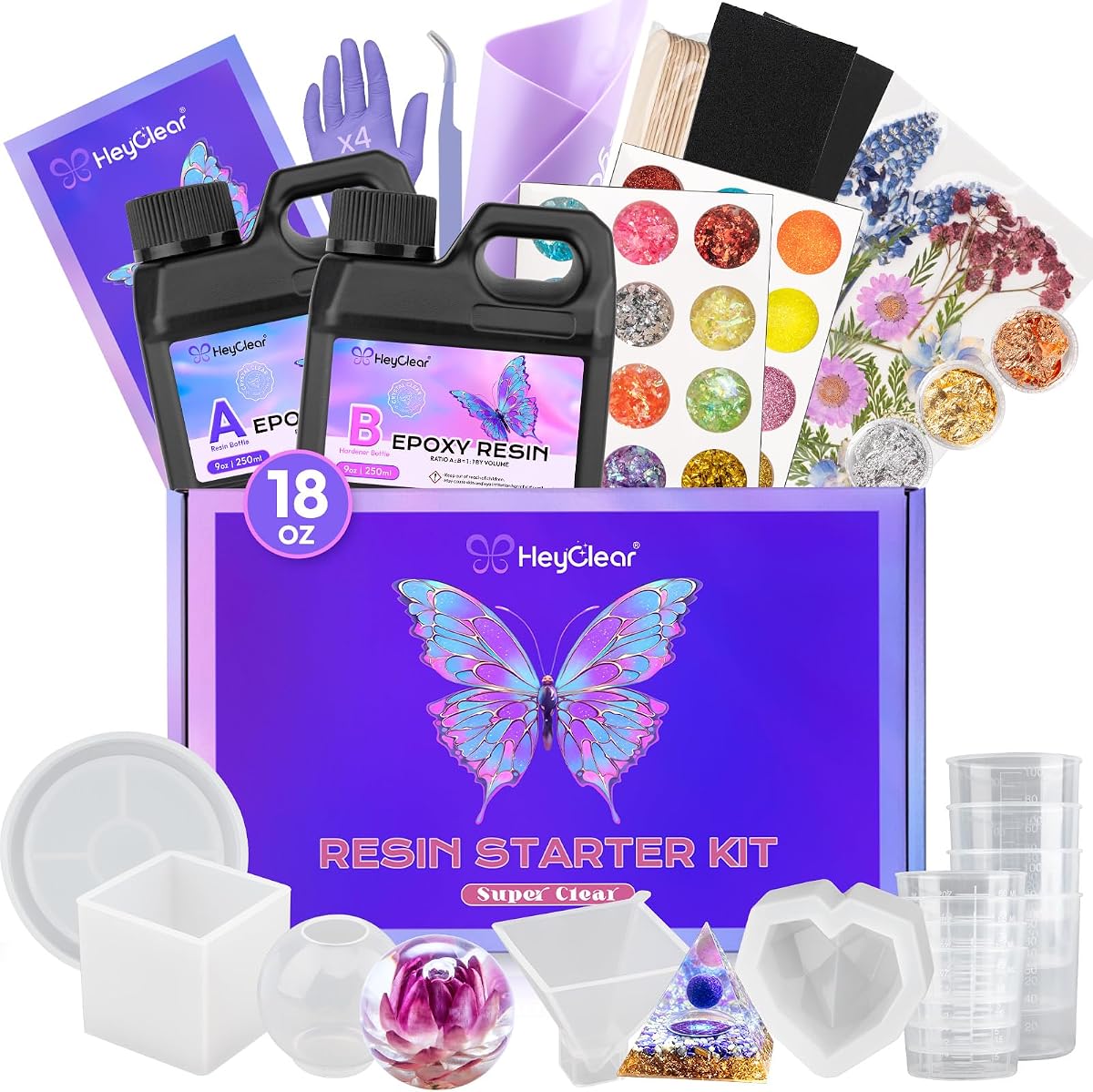
Where the coaster kits go deep on one shape, the HeyClear goes wide. Its 83 pieces include 18 oz of epoxy (9 oz + 9 oz, 1:1), 5 silicone molds — sphere, pyramid, heart-diamond, cube, and round — a silicone work mat, 18 dried flowers, 12 colors of glitter plus 12 chunky glitter flakes, gold foil in 3 colors, measuring cups in two sizes, gloves, droppers, tweezers, sandpaper, and an instruction manual. That makes it the best first kit for a beginner who does not yet know their product: in one weekend you can cast a flower sphere, a pyramid, and a heart, and find out which shape you actually enjoy making — and which one photographs like a product. The mat alone saves your table; resin drips are forever.
Honest pros:
- 5 different molds — jewelry, decor, and keepsake shapes, not just coasters
- Dried flowers, two glitters, and foil included — the preserved-flower look is ready to try
- Silicone mat, sandpaper, and two cup sizes — the unglamorous tools you actually need
- Gift-ready box — the presentable pick for a crafty beginner
Honest cons:
- 18 oz spread across 5 molds means one or two pieces per shape, not a product run
- 3D molds (sphere, pyramid) are less forgiving than flat coasters — expect a learning pour
- No liquid pigments — color comes from glitter and flowers unless you add your own
LET'S RESIN 34 oz Epoxy Resin Kit — the resin-only step up
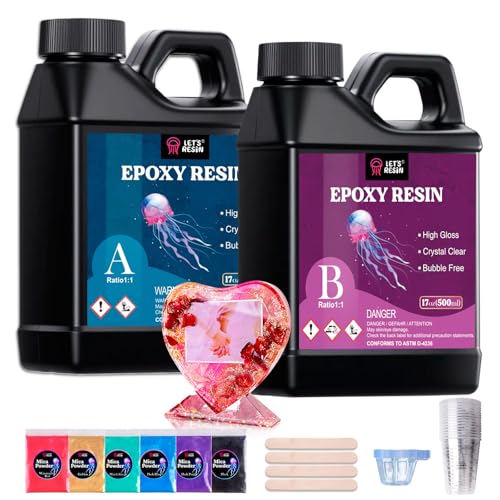
Read the box carefully: this is resin and color, not a mold kit — and for a maker on their second or third batch, that is exactly right. You get 34 oz of epoxy (17 oz resin + 17 oz hardener in handled jugs), 6 mica powder colors, and basic cups and sticks. No molds, because by now you own the molds you like. The formula is the same beginner-friendly 1:1 casting resin as the coaster kit — low odor, self-defoaming, crystal clear, curing in 8–24 hours — at a list price of $23.99 for more than double the resin of a 16 oz starter. This is how resin gets cheap: stop re-buying molds and gloves in every box, and buy the liquid by the ounce. If you are a true beginner with no molds at all, start with one of the complete kits above and come back here for your restock.
Honest pros:
- 34 oz at a $23.99 list price — the lowest cost per ounce on this list
- 6 mica colors included — the essential shimmer palette for coasters and trays
- Handled 17 oz jugs pour and store better than small bottles
- Same 1:1, low-odor formula as the beginner coaster kit — no new learning curve
Honest cons:
- No molds and minimal tools — useless on its own for a first-ever pour
- Mica only — liquid pigments for ocean effects are a separate buy
- Still a shallow-cast resin (about 1 inch per pour) — not for deep molds or river tables
KISREL UV Resin Jewelry Making Kit — the fast-cure pick
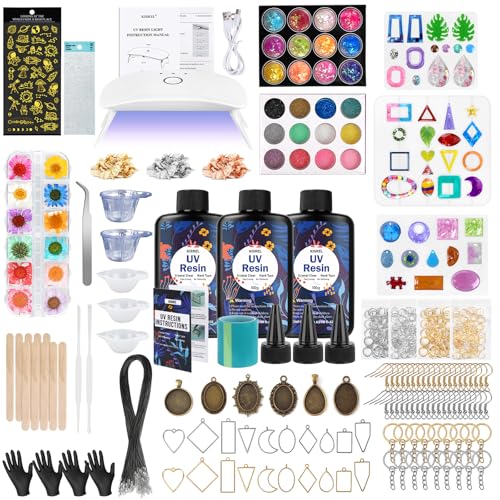
UV resin plays by different rules: no measuring, no mixing, no overnight wait. You pour from the bottle, add color or a dried flower, and cure it under the included UV lamp in minutes. The KISREL kit bundles 300 g of hard-type UV resin with the lamp (USB-C powered), silicone molds, open bezels and pendant trays, earring hooks, keychain hardware, jump rings, dried flowers, glitter, mica colors, mixing cups, sticks, and gloves — a complete small-jewelry workshop. For earrings, pendants, and keychains, the speed changes the hobby: you can test five designs in an afternoon instead of one pour per day. The trade-offs are just as real: UV resin only cures in thin, clear layers where light can reach, it shrinks a little as it cures, and per gram it costs far more than epoxy — coasters and trays would be slow and expensive. Small and fast, or big and patient: pick per project, and many sellers end up owning both.
Honest pros:
- Cured in minutes under the included lamp — design, pour, and finish the same afternoon
- No mixing and no ratio mistakes — the #1 beginner failure mode is designed out
- Jewelry findings included (hooks, bezels, keychain hardware) — finished, wearable pieces, not just castings
- 300 g across three bottles — a generous UV quantity for small pieces
Honest cons:
- Thin, transparent layers only — dark colors and deep molds cure poorly or not at all
- Highest cost per gram here — the wrong choice for coasters, trays, or anything large
- Slight shrinkage and a lamp dependency — pieces are small by design
Side-by-side
| LET'S RESIN Coaster Kit | KISREL 32 oz | Teexpert | HeyClear | LET'S RESIN 34 oz | KISREL UV Kit | |
|---|---|---|---|---|---|---|
| Typical price | Check latest price | Check latest price | ~$30 | Check latest price | $23.99 list | Check latest price |
| Resin type | Epoxy, 16 oz | Epoxy, 32 oz | Epoxy, 16 oz | Epoxy, 18 oz | Epoxy, 34 oz | UV resin, 300 g |
| Mix / cure | 1:1 · 8–24 hrs | 1:1 · full-day cure | 1:1 · demold 8–10 hrs | 1:1 · full-day cure | 1:1 · 8–24 hrs | No mix · minutes under lamp |
| Molds | 3 coaster shapes | Coaster molds | 4 coaster molds | 5 shapes (sphere, pyramid, heart, cube, round) | None | Jewelry molds + bezels |
| Color included | Mica colors | 8 pigments + 6 mica + flowers | 6 pigments + 3 mica + flakes | Glitter + flowers + foil | 6 mica colors | Glitter + mica + flowers |
| Best for | Best overall | Most resin for the money | Ocean coasters | Trying many shapes | Restocking resin only | Fast small jewelry |
How to choose
Pick the resin type before the brand. Two-part epoxy (the first five kits) is the default for a reason: cheap per ounce, strong, and right for coasters, trays, and anything flat or chunky — at the cost of a full-day cure and an exact 1:1 mix. UV resin (the KISREL UV kit) removes mixing and waiting entirely, but only for small, thin, jewelry-scale pieces. Decide what you want to make first; the kit follows from that.
Do the ounce math before you buy. Before your first pour, fill a mold with water and pour the water into a measuring cup — that is exactly how much mixed resin that mold takes. A 16 oz kit is a handful of coasters or a dozen small pendants; 32–34 oz is a first product batch. Beginners burn resin on practice pours, so the bigger kits (KISREL 32 oz, LET'S RESIN 34 oz) are better value than their sticker suggests.
Warm resin, slow stir, thin pours. The three habits that separate clear pieces from cloudy, bubbly ones: warm the resin bottle in a bowl of warm water before mixing in a cool room, stir slowly for 3–5 minutes and scrape the cup's sides, and pour in thin layers (about an inch at a time for these casting resins), passing a heat gun or kitchen torch quickly over the surface to pop bubbles. A sticky, soft cure almost always means the ratio was off or the cup was under-mixed — measure by volume in the same cup, every time.
Work safe, sell safer. Liquid resin is a skin sensitizer: wear the gloves in the box, work ventilated, and keep uncured resin off skin and out of the sink. Let pieces cure fully — days, not just the demold time — before selling or shipping them, and do not market craft resin as food-safe for direct food contact unless the specific product states it; coasters are fine (a mug sits on top), cutting boards and cups are a different claim. When your first pieces are ready, photograph them with our product photography lighting guide, finish your jewelry pieces with our jewelry making tools guide, and ship them safely with our packaging supplies guide.
FAQ
Epoxy resin or UV resin for a beginner?
Epoxy for most: it is cheaper per project, more forgiving in molds, and right for coasters and decor — you just wait a day per pour. UV resin is better when your pieces are small jewelry and you want finished results in minutes, or you keep ruining epoxy ratios. Many sellers start on epoxy and add UV later for earrings and quick prototypes.
Why did my resin stay sticky or soft?
Almost always one of three causes: the ratio was off (measure resin and hardener by volume, in equal amounts, using marked cups), the mix was incomplete (stir slowly 3–5 minutes, scrape the sides and bottom, then pour into a second cup and mix again), or the room was cold (these resins cure best around 70–80°F — warm the bottles in warm water first). A thin, tacky surface layer can also be amine blush from humidity; a fully soft piece cannot be rescued and is a measurement lesson, not a product defect.
How do I get the bubbles out?
Warm resin before mixing, stir slowly instead of whipping, let the mixed cup rest a few minutes so bubbles rise, pour in a thin stream from a height, and pass a heat gun or torch flame quickly across the surface after pouring — do not hold heat in one spot. Small bubbles deep in a pour are the hardest to remove, which is why thin layers beat one deep pour for clear pieces.
Can I sell resin pieces made from a kit?
Yes — many Etsy resin shops started with exactly these kits. Selling adds three duties the hobby pour does not have: cure every piece fully before it ships (soft pieces bend and fingerprint in the mail), be accurate in listings about materials and care (resin coasters dislike hot pans and dishwashers), and never claim food-contact safety the resin does not carry. Price in your practice pours — the first batch of any new mold is R&D, not inventory.
How long does resin last once opened?
Unopened epoxy kits here carry roughly a 1-year shelf life, and opened bottles keep for months if they are sealed promptly and stored cool, dark, and dry. Hardener slowly yellows with age and air exposure — old hardener is the most common cause of a yellow cast in "crystal clear" pieces. UV resin also degrades with light exposure; store the bottles in their box, away from windows.