
Best Photo Light Boxes for Small Products (2026)
Small products are the hardest things to photograph well. A ring, a candle, or a bar of soap shot on a kitchen table picks up every problem in the room: a yellow ceiling light on one side, a dark shadow on the other, a window reflection across anything glossy, and a background that changes every time you move. A photo light box fixes all four problems at once. It surrounds the product with soft, even light, puts it on a clean seamless backdrop, and — the part sellers actually pay for — gives you the same photo at 9 a.m. and 9 p.m., in January and in June. Consistency is what makes a shop grid look like a brand instead of a yard sale.
What separates the good boxes from the toys is not the box. It is the light: how many LEDs, whether you can dim them, and the CRI rating, which tells you how truthfully colours render — look for CRI 95 or higher if you sell anything where colour is the product, like yarn, fabric, lipstick, or resin. Size is the second decision, and it is a simple rule: your product should take up no more than about half the width of the box, or the walls crowd the shot and the light stops being even. The six boxes below run from an 8-inch mini for rings and earrings up to a 25-inch fold-flat studio for shoes and handbags, and every one of them works with the phone already in your pocket.
The short answer
- Best overall: DUCLUS Light Box, 16 x 16 inch (~$57) — 160 dimmable LEDs at 5500K with a CRI of 97+, eight backdrops, and front and top shooting openings. The right size and the right light for most small products. Check price on Amazon →
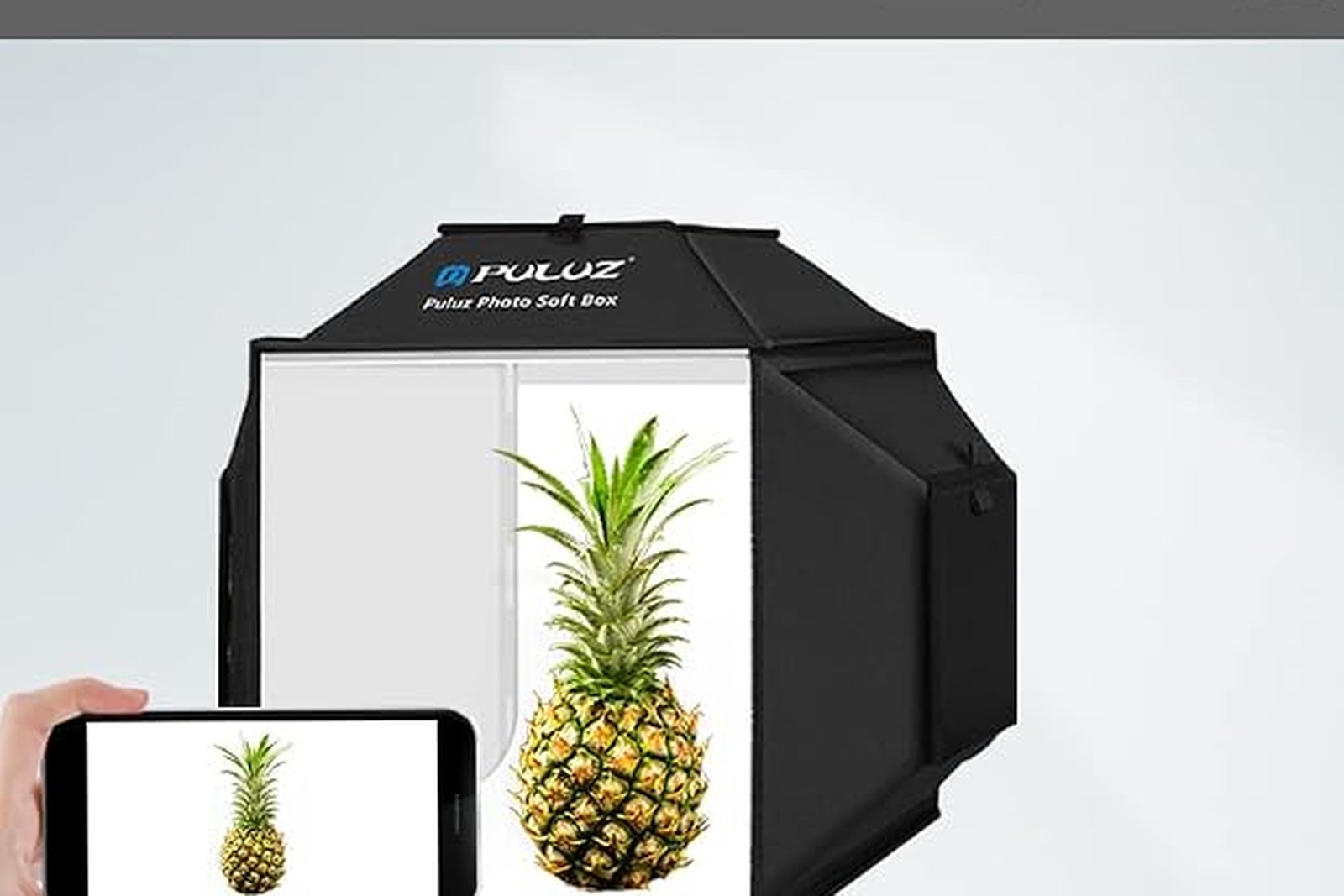
- Best for glossy & reflective products: PULUZ 16 x 16 inch Upgrade — 480 LEDs and wraparound soft panels that spread reflections into soft gradients on glass, bottles, and polished metal, with 4 PVC backdrops. Check price on Amazon →
- Best compact: Lightdow 12 x 12 inch — 120 LEDs with a CRI above 95, 6 backdrops, and a desktop tripod in the box, sized for jewellery, watches, and cosmetics. Check price on Amazon →
- Best budget for jewellery: PULUZ Mini, 20 cm (about 8 inch) — two 20-LED light bars, 6 colour backdrops, USB power, and a fold-flat body that lives in a drawer between shoots. Check price on Amazon →
- Best premium fold-flat: ORANGEMONKIE Foldio3, 25 inch — a rigid all-in-one studio that folds flat with magnetic panels, triple LED strips with a dimming controller, and white and black backdrops included. Check price on Amazon →
- Best large, no assembly: Amazon Basics Photo Studio, 25 x 30 x 25 inch (~$111) — built-in LED light, no assembly at all, and it folds into its own carrying case; the one to pick for shoes, bags, and small appliances. Check price on Amazon →
DUCLUS Light Box, 16 x 16 inch — the best overall
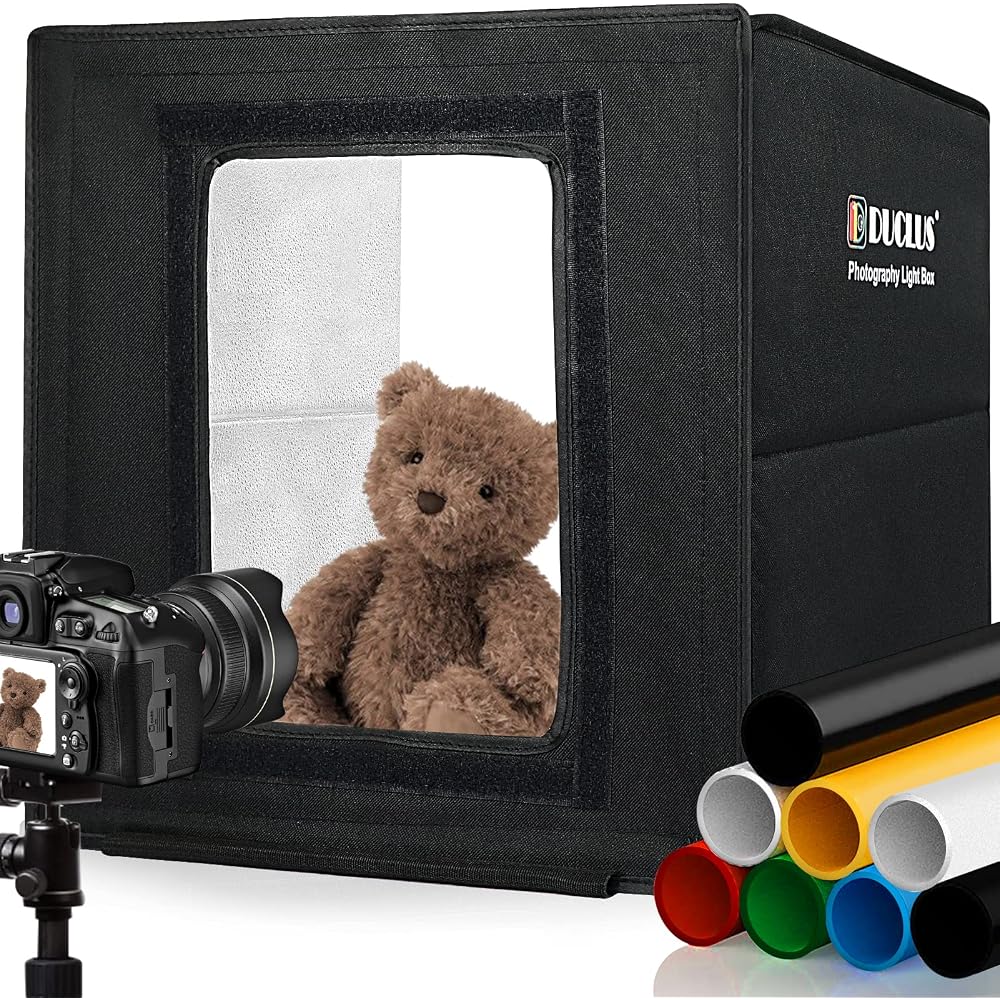
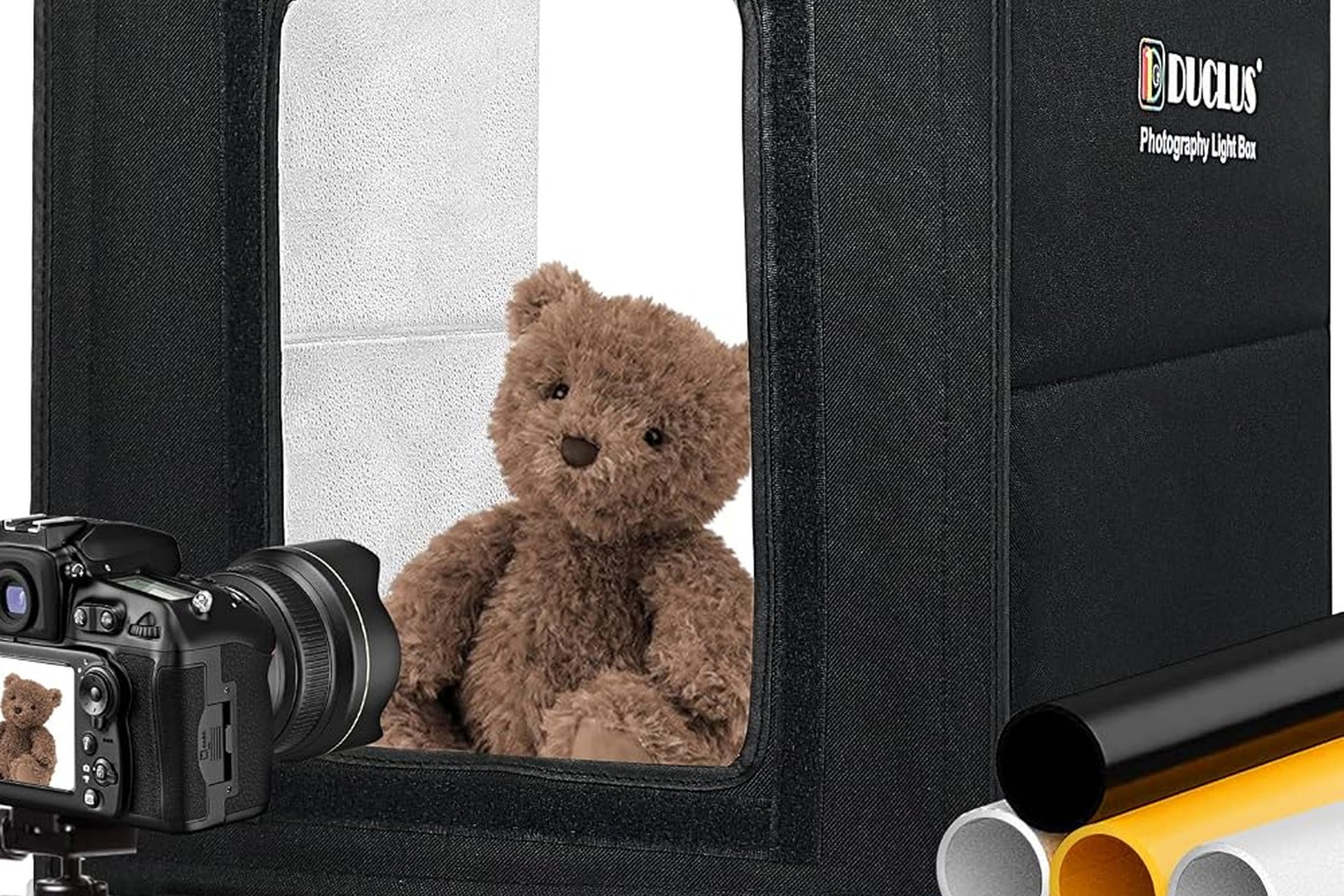
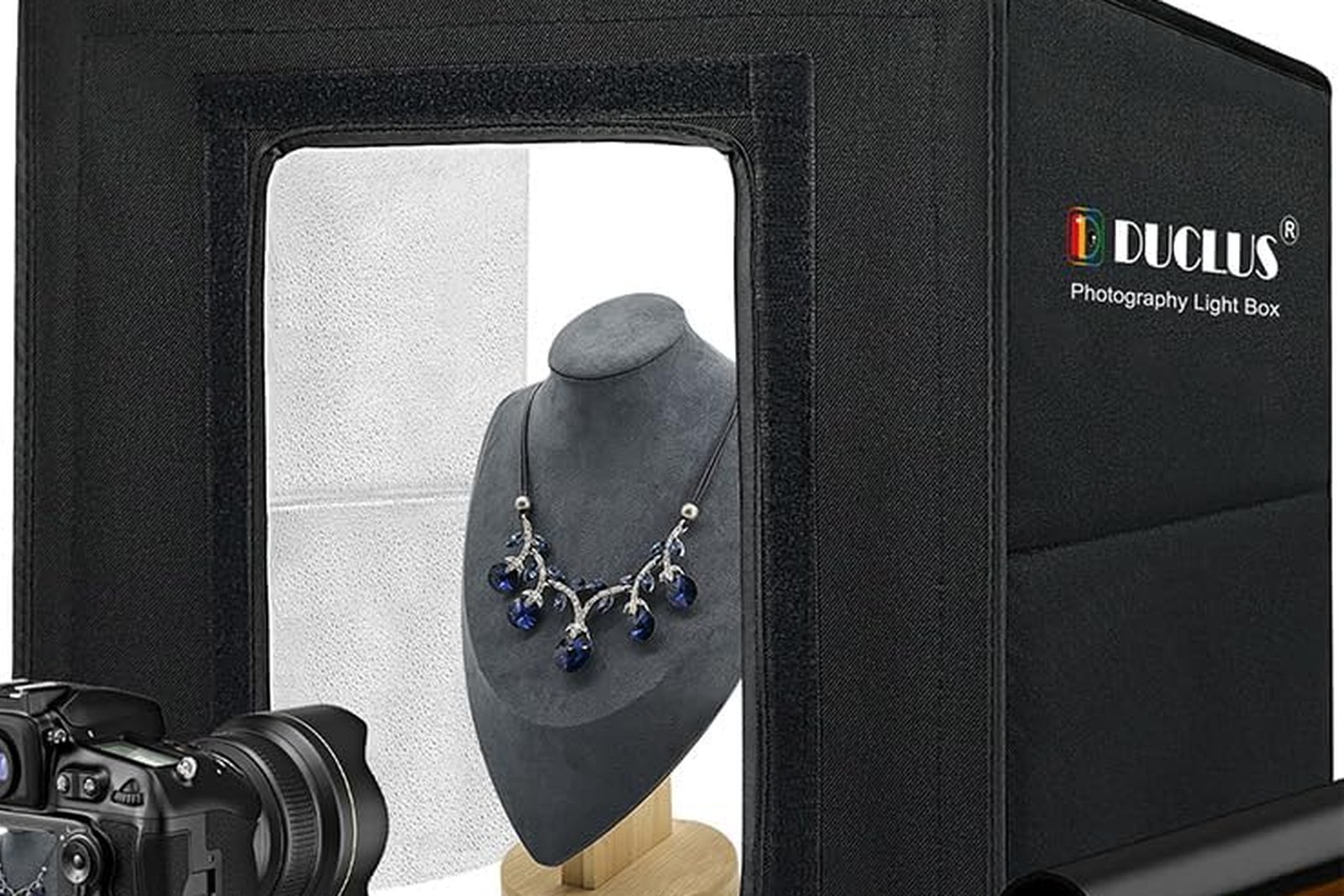
If you sell a mix of small products and want one box that handles almost all of them, this is it. The DUCLUS is a 16-inch cube with 160 dimmable LEDs in the roof, a 5500K daylight colour temperature, and a CRI of 97+ — the number that matters most for sellers, because it means the red in your photo is the red your customer receives. Brightness adjusts in levels, so a white product on a white backdrop does not blow out and a dark product does not go muddy. You get eight backdrops (six PVC and two paper), a reflective front panel you can shoot through for glossy items, and openings at the front and the top, so flat lays and straight-on shots come from the same box. It runs from a USB-C supply — note that it needs an 18W or stronger adapter, which is not included, so budget for a decent phone-charger brick if you do not already own one. Sixteen inches is the sweet spot size: candles, mugs, soaps, cosmetics, small toys, and most shoes fit with room to spare, and the box folds away when the shoot is done.
Honest pros:
- CRI 97+ at 5500K — colour-accurate light, the single most important spec for product photos
- 160 dimmable LEDs — enough brightness control for white-on-white and dark products alike
- Eight backdrops and front + top shooting openings cover flat lays, gloss, and standard shots in one box
- The 16-inch size fits the widest range of small products without eating a whole desk
Honest cons:
- The required 18W+ power adapter is not included — it will not run properly off a weak laptop USB port
- Handbags, boots, and anything much over 8–10 inches wide crowd it — step up to a 25-inch box instead
- Paper backdrops crease if you store them folded; keep them rolled like the PVC ones
PULUZ 16 x 16 inch Upgrade — the best for glossy & reflective products
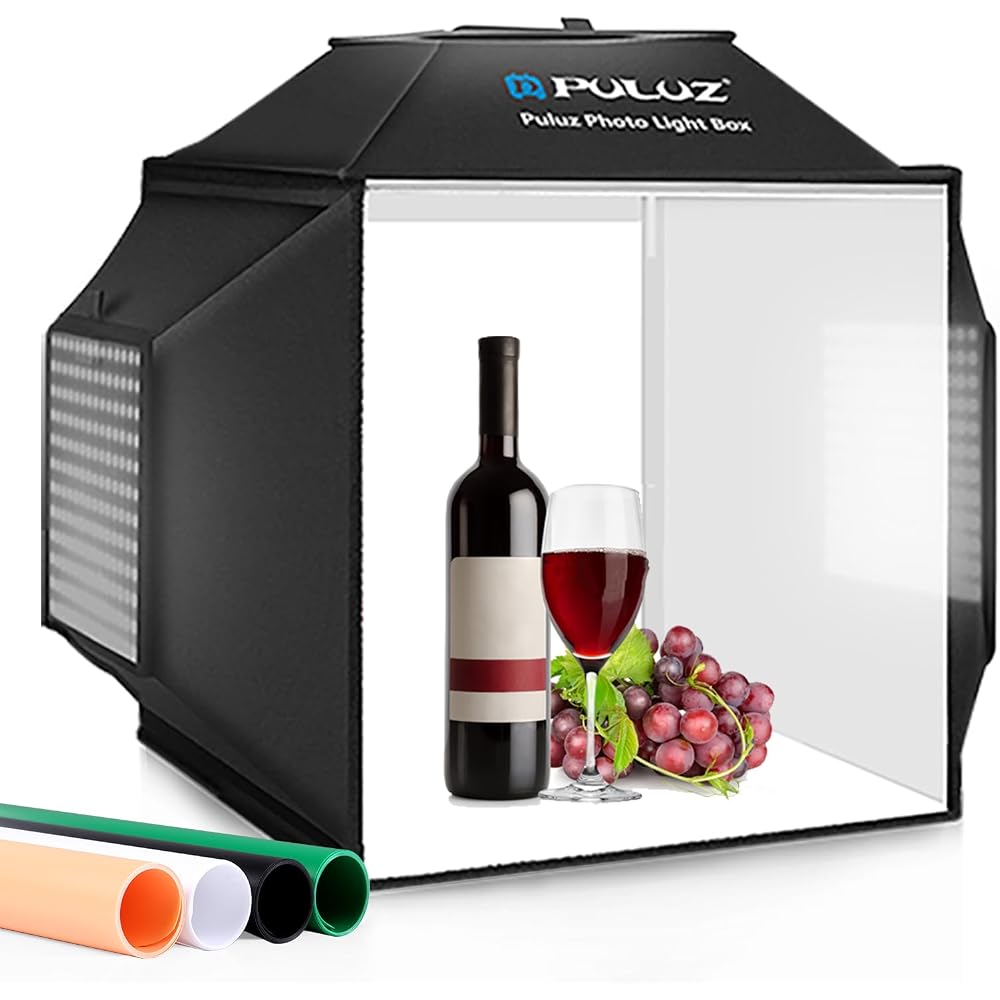
Glossy products — perfume bottles, glazed ceramics, polished jewellery, anything in shiny packaging — are where cheap light boxes fail, because a single strip of LEDs prints itself across the product as one hard white stripe. The PULUZ Upgrade attacks that problem with sheer coverage: 480 LED beads spread across its panels, with a listed CRI of 95+, so light wraps the product and reflections soften into broad, gentle gradients instead of stripes. It is the same useful 16-inch footprint as the DUCLUS, with four colour PVC backdrops and front and top shooting positions, so you can shoot a bottle straight on and a flat lay from above without rebuilding your set. Dimming lets you pull the brightness down for chrome and mirror finishes, which is exactly the control reflective products need. If your shop is mostly matte — soap, candles, paper goods — the DUCLUS above is the simpler buy. If your products shine, this is the box that makes them look expensive instead of streaky.
Honest pros:
- 480 LEDs — the most wraparound light in this size class, and it shows on glass and polished metal
- Dimmable output, so you can tame reflections on chrome, gloss packaging, and glazed ceramics
- Front and top shooting positions for straight-on and flat-lay shots
- Four PVC backdrops — wipe-clean, unlike paper, when a cosmetic or food product spills
Honest cons:
- Four backdrops is fewer than the DUCLUS set — colour variety is thinner out of the box
- Maximum light coverage is wasted on matte products; you are paying for a gloss problem you may not have
- Like every 16-inch box, it is not a shoe-and-handbag studio — check your biggest product first
Lightdow 12 x 12 inch — the best compact
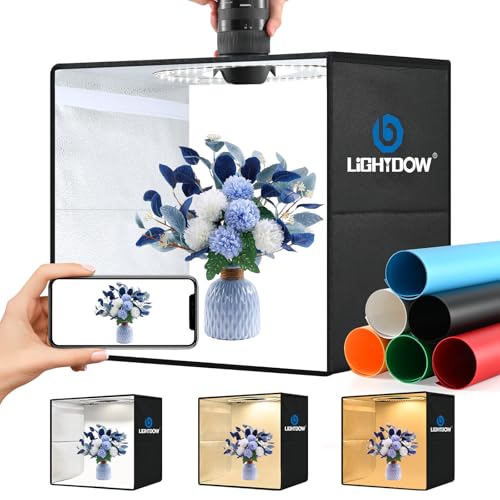
Twelve inches sounds small until you list what actually fits in it: rings, earrings, watches, coins, trading cards, lipsticks, and most cosmetics — the entire inventory of a jewellery or beauty shop. The Lightdow packs 120 LEDs with a CRI above 95 into that cube, includes six backdrops, and — the detail that earns it this spot — puts a desktop tripod in the box. A light box with a handheld phone still gives you slightly different framing on every shot; a light box with a tripod gives you a repeatable station, which is how a 40-listing shop grid ends up looking like one photographer took it. The box folds for storage, and the smaller cube has a quiet advantage: less empty space means the light is more even across a tiny subject, and small products shot in a big box tend to look lost and grey. If everything you sell fits in your hand, buy the box sized for your hand.
Honest pros:
- Desktop tripod included — a repeatable shooting station, not just a box
- 120 LEDs with CRI above 95 in a cube sized for jewellery-scale products
- Six backdrops, and the compact cube lights small subjects more evenly than a big empty box
- Folds down for storage between shoots — right for a desk that does other jobs
Honest cons:
- Hard ceiling on product size: candles in large jars, mugs, and shoes simply do not fit
- The included tripod is a desktop mini — fine for a phone, not a perch for a heavy DSLR
- No room for props or a hand model shot; it is a packshot box, not a lifestyle set
PULUZ Mini, 20 cm — the best budget for jewellery
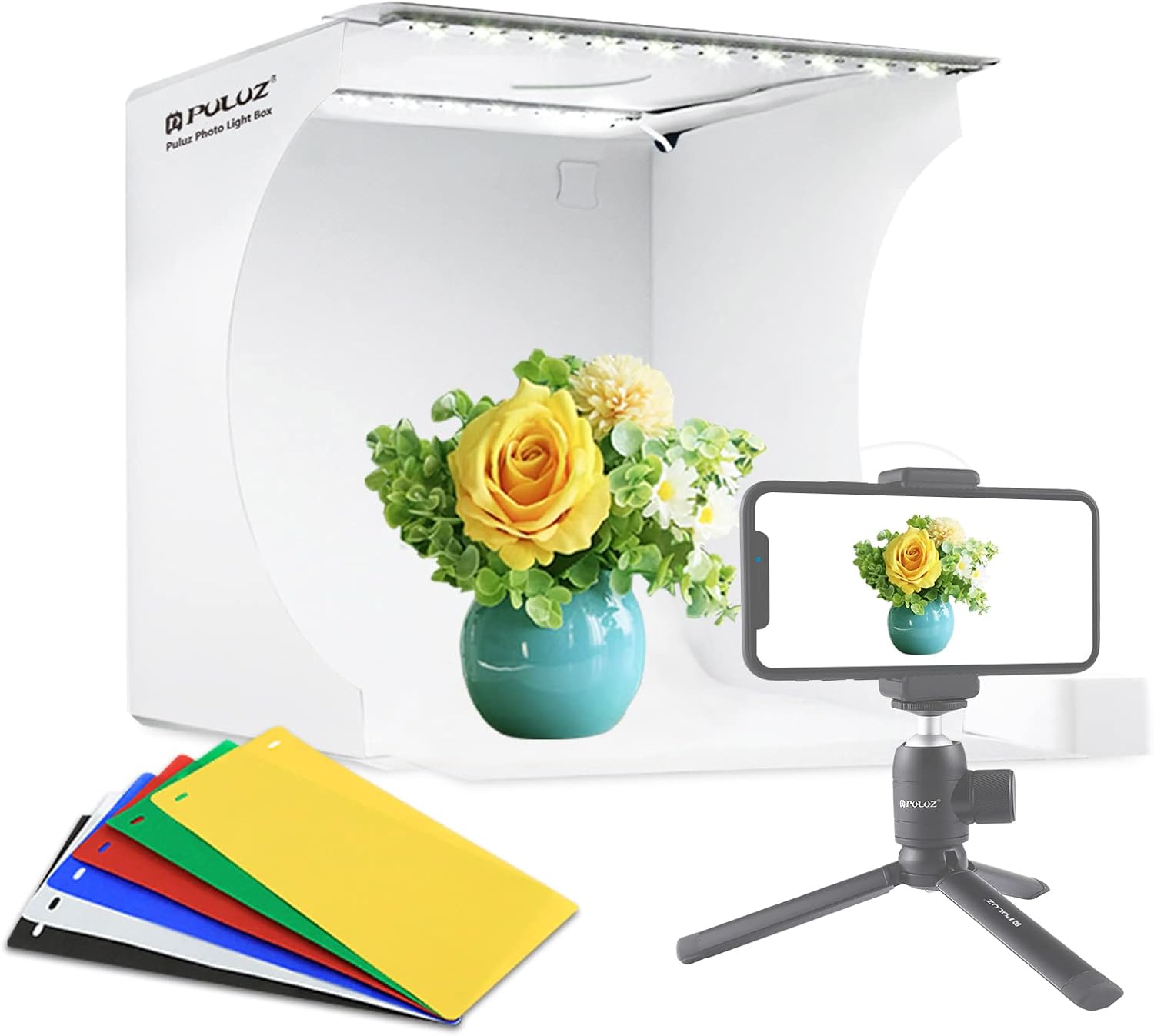
The PULUZ Mini is the light box for one specific seller: you make or resell small jewellery, you shoot a handful of pieces at a time, and you do not have a spare desk to give a studio. The box is about 8 inches across, lit by two light bars of 20 LEDs each at 5500K, powered by USB — a power bank on the table works — and it folds completely flat, so it stores in a drawer and sets up on a tray table. Six colour backdrop sheets are included, which matters more at this scale than sellers expect: at 8 inches, the backdrop is most of the photograph, and swapping white for black is the difference between silver looking bright and silver looking invisible. Be clear-eyed about the ceiling, though. Eight inches fits rings, earrings, pendants, brooches, coins, and watches — and nothing else. The day your line grows to candles or cosmetics bottles, this becomes your jewellery-only box and you will buy a 16-inch box next to it. At its price, that is a fair deal, not a failure.
Honest pros:
- The cheapest credible way to get even, shadow-light photos of rings and earrings
- Folds flat and runs on USB — shoots anywhere, stores in a drawer
- Six backdrop colours included; black makes silver and clear stones readable
- Two light bars soften shadows better than the single-strip minis sold at this size
Honest cons:
- About 8 inches is a hard limit — earrings and rings only, no exceptions for “small” candles
- 40 LEDs total is modest light; keep the room lights off so the box is the only source
- No dimmer finesse to speak of — you control exposure from the phone, not the box
ORANGEMONKIE Foldio3, 25 inch — the best premium fold-flat
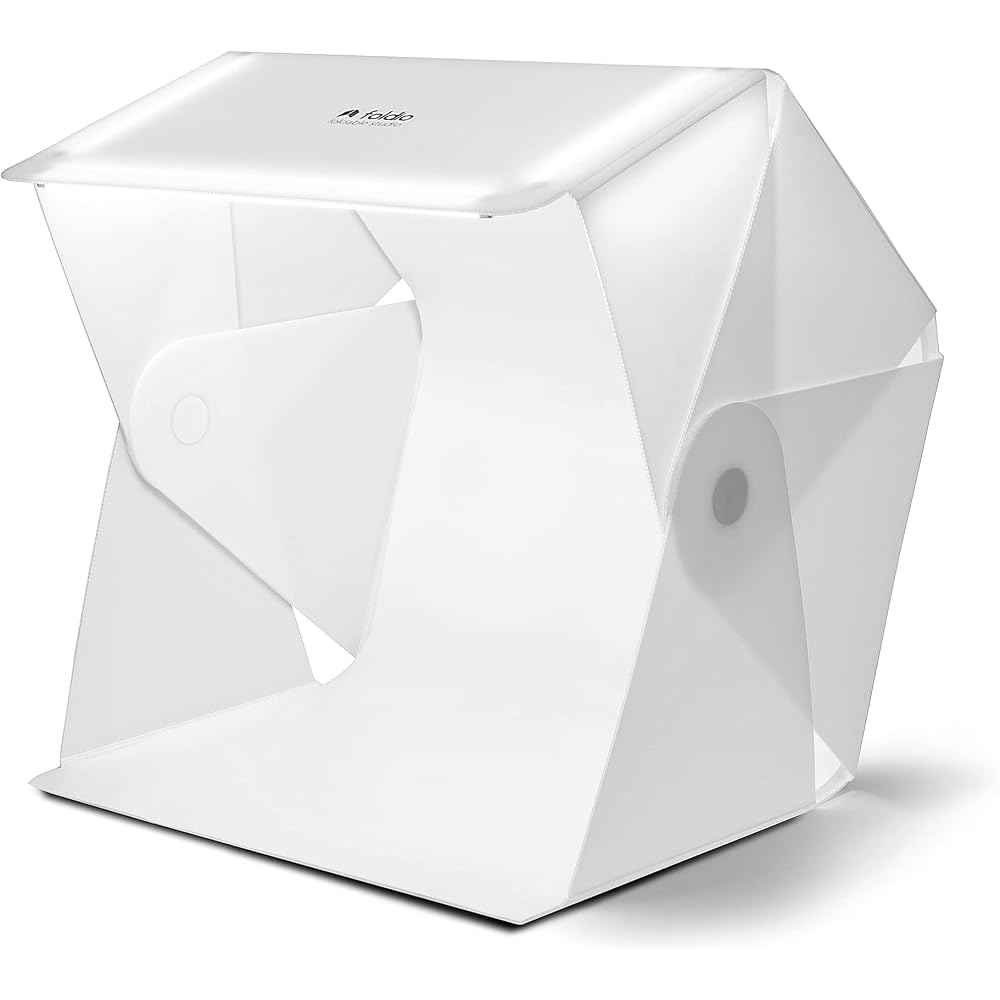
The Foldio3 is what the other boxes on this page are imitating. ORANGEMONKIE built the original foldable studio, and the Foldio3 is the 25-inch version: rigid white plastic panels that snap together with magnets and fold flat again, triple LED strips with a dimming controller, and a backdrop sheet — white, with a black flocking backdrop in the linked set — that unrolls into a clean sweep. At 25 inches it photographs the products the 16-inch boxes cannot: shoes, handbags, helmets, larger toys, and small appliances, while still doing jewellery duty with the dimmer turned down. The listed specs are the strongest here, including a very high CRI claim and a 65W lighting system; in practice, what you feel is the build — panels that stay square, a box that opens to the same shape every time, and parts that are still sold years later. The honest price of that is money: it costs several times a basic 16-inch box, and its best accessories — the Halo Bars side lights and the 360 turntable — are separate purchases, not included. Buy it if photography is a weekly production task for a growing catalogue, not for ten listings a month.
Honest pros:
- 25 inches of real working room — shoes, bags, and appliances fit with space to compose
- Rigid magnetic panels fold flat and rebuild to the same square shape every time
- Triple LED strips with a proper dimming controller — one box from jewellery to footwear
- A mature accessory ecosystem (side lights, turntable) if your studio grows into it
Honest cons:
- Several times the price of a good 16-inch box — overkill for small catalogues
- Halo Bars and the turntable are extras; the base price buys the studio, not the full system
- On a small desk, 25 inches is a presence — measure your shooting corner before ordering
Amazon Basics Photo Studio, 25 x 30 x 25 inch — the best large, no assembly
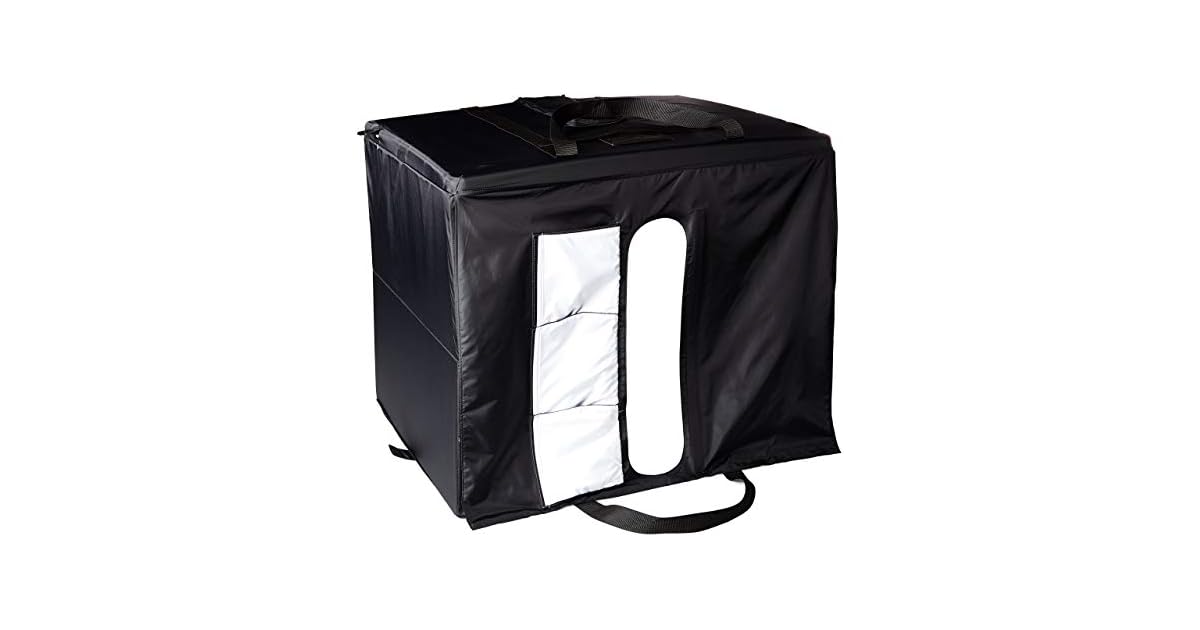
Every other box here asks for a few minutes of unfolding, clipping, or snapping panels. The Amazon Basics studio asks for none: it opens from its own carrying case — handles and all — into a 25 x 30 x 25 inch shooting space with built-in LED lighting and a white backdrop, and folds back into the case when you are done. That depth is its real distinction. Thirty inches front to back fits the awkward products that defeat square cubes: a handbag with its handles up, a pair of boots, a small appliance, a gift basket. Front and top openings cover the standard angles, and the whole thing stores like a portfolio on a shelf, which is why it is a favourite of sellers who shoot a big batch once a month and want their table back in between. The trade-offs are control and light shaping: the built-in lighting is a fixed, simple system rather than a dimmer-driven one, and there is no backdrop wardrobe — white is the look. If your products need colour-accurate, carefully dimmed light, the DUCLUS and Foldio3 are better tools. If your products are large and your priority is “set up in a minute, shoot, put it away,” this is the one.
Honest pros:
- Zero assembly — it unfolds from its carrying case and folds back into it
- The deepest box here: 25 x 30 x 25 inches swallows boots, bags, and small appliances
- Built-in LED light and backdrop included — nothing else to buy to start shooting
- Stores flat like a portfolio case; the studio disappears between batch shoots
Honest cons:
- Fixed, simple lighting — no dimmer control for glossy or very dark products
- White backdrop only; no colour options for brand-matched shots
- Its size is wasted on jewellery-scale products, which look lost in a 30-inch-deep box
Side-by-side
| DUCLUS 16" | PULUZ Upgrade 16" | Lightdow 12" | PULUZ Mini | Foldio3 25" | Amazon Basics | |
|---|---|---|---|---|---|---|
| Box size | 16 x 16 in | 16 x 16 in | 12 x 12 in | ~8 in (20 cm) | 25 in | 25 x 30 x 25 in |
| LEDs | 160, dimmable | 480 | 120 | 40 (2 bars) | Triple strips, dimmer | Built-in, fixed |
| Colour accuracy | CRI 97+, 5500K | CRI 95+ | CRI >95 | 5500K | High CRI (listed 98+) | Not CRI-rated |
| Backdrops | 8 (6 PVC + 2 paper) | 4 PVC | 6 | 6 colours | White + black | White |
| Typical price | ~$57 | Check current price | Check current price | Check current price | Check current price | ~$111 |
| Best for | Most small products | Glossy & reflective | Jewellery, watches, cosmetics | Rings & earrings on a budget | Shoes, bags, growing catalogues | Large items, batch shoots |
How to choose
Size the box to your biggest regular product — then check the half-width rule. A product should sit at no more than about half the box's width, with backdrop curving behind it and light wrapping it. Rings and earrings: the PULUZ Mini or the Lightdow. Candles, soaps, mugs, and cosmetics: a 16-inch box. Shoes, bags, and appliances: a 25-inch box. Buying one size up “for later” is the common mistake — small products in an oversized box photograph grey and distant, so a second small box later is a better plan than one big box now. Whichever size you land on, the staging around it matters too — our photography backdrops guide covers the surfaces and sweeps for the shots a light box cannot do.
Read CRI before LED count. LED count is brightness and coverage; CRI is truth. A CRI of 95 or higher keeps reds, skin tones, and fabric colours honest, which is return prevention for colour-sensitive products — a buyer who receives a different colour than the photo sends the product back. If a listing hides its CRI entirely, treat that as information: it is the first spec a good light box advertises. For the products where a box is the wrong tool entirely — large, textured, or lifestyle-led — our product photography lighting guide covers panels, tents, and bulbs instead.
Shoot like a station, not an event. The sellers who get value from a light box batch their photography: box on the table, phone on a tripod, room lights off, white balance locked to daylight, every product shot front, angle, detail, and scale in the same order. Ten minutes of setup buys you a catalogue that looks shot on one day — because it was. Clean the backdrop before every batch (PVC wipes down; that is a real argument for PVC over paper), iron out backdrop creases with low heat or steam, and keep one black backdrop in the kit: silver, glass, and white products only become readable against black.
Know what a light box cannot do. It gives you clean packshots, not a brand. Lifestyle photos — the candle on a mantel, the bag on a shoulder — still need a backdrop, a window, and the styling work in our backdrops guide. And a light box flattens: products that sell on texture, like knitwear or carved wood, sometimes photograph better in soft side light than in shadowless box light. Own the box for your catalogue shots, and keep your window for the hero shots.
FAQ
What size light box do I need for jewellery?
For rings, earrings, and pendants, an 8- to 12-inch box is ideal — the PULUZ Mini or the Lightdow above. Small boxes light small subjects more evenly, and a necklace on a bust needs the 12-inch size. Save the 16-inch boxes for when your line grows beyond jewellery.
Can I just use my phone?
Yes — every box here was designed around phone photography, and a current phone in a light box out-photographs a DSLR on a kitchen table. Put the phone on a tripod or the included mini tripod, lock the exposure by long-pressing on the product, and keep the room lights off so the box's LEDs are the only light source.
Why do my white backgrounds come out grey?
Your camera is exposing for the whole scene and protecting the highlights, so the white backdrop lands at mid-grey. Fix it in order: raise the box brightness or move the product closer to the lights, tap the product to set focus, then raise the exposure slider until the backdrop just turns white — and stop there, or the product's own highlights blow out with it.
What does CRI mean, and why does it matter?
CRI (Colour Rendering Index) measures how truthfully a light shows colours, out of 100. Daylight is effectively 100. Below about 90, reds go dull and fabrics shift — the photo lies about the product, and the lie comes back as a return. Every serious pick on this page is CRI 95 or higher.
Is a light box worth it if I already have a ring light?
They do different jobs. A ring light is one hard source that makes a bright circle reflection — good for faces and video, poor for packshots. A light box surrounds the product with diffused light from several sides, which is what removes shadows and table clutter from a product photo. Sellers who shoot stills use the box more; the ring light earns its keep on live and video.